

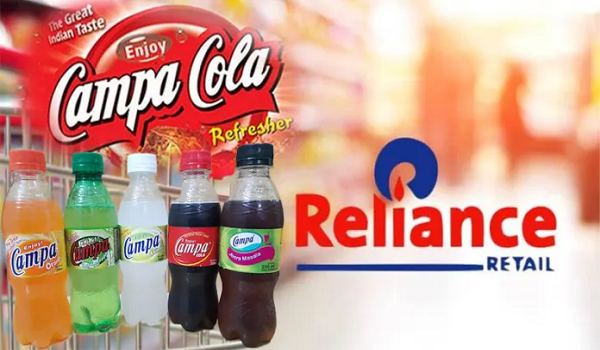
In what may become the most disruptive move in India’s soft drink market in decades, Reliance Consumer Products Ltd (RCPL), the FMCG arm of Reliance Retail Ventures, is set to invest a staggering ₹8,000 crore in its beverages business over the next 12 to 15 months. The goal? To resurrect the iconic Campa Cola and build a formidable portfolio of mass-market beverages that rival global giants like Coca-Cola and PepsiCo.
The aggressive capital expenditure will power the development of 10 to 12 new manufacturing plants, both greenfield and through co-packing arrangements, significantly boosting RCPL’s production footprint. The company already operates through 18 such co-invested facilities. With this fresh infusion of funds, Reliance targets national availability of its beverage brands by March 2027, aiming for 70% market coverage as early as next year.
“This capex, pegged between ₹6,000-₹8,000 crore, is being funded jointly by Reliance and some of its regional partners,” said an executive familiar with the development.
A Multibrand Offensive
RCPL’s current beverage bouquet includes:
Campa Cola, Campa Orange & Lemon
Sosyo (heritage brand from Gujarat)
Spinner Sports Drink
Sun Crush Juice
RasKik (fruit-based hydration)
Independence Water
The portfolio straddles carbonated soft drinks, energy beverages, juices, and packaged water—segments dominated for years by a handful of MNCs. But Reliance is doing more than just playing catch-up.
Its pricing strategy is aggressively tuned for India’s mass market, with beverages priced 20–40% lower than competitors. Spinner, for instance—a co-created sports drink with Sri Lankan cricketer Muttiah Muralitharan—is priced at just ₹10 for a 250 ml bottle, a stark contrast to PepsiCo’s Gatorade and Sting.
“We are looking at 600 million mass consumers and enabling local retailers with margins they can actually work with,” said T Krishnakumar, Director of RCPL and former Coca-Cola India head, in a recent interview. “For any product to be scaled in an intense manner, you need 24 to 30 months.”
From Guwahati to Gaya: Plants Go Regional
To support this beverage blitzkrieg, RCPL is setting up plants across multiple states. The Guwahati facility, a joint venture with Jericho Foods and Beverages LLP, is already operational and catering to the Northeast. Another plant is under development in Bihar. These facilities are designed to serve regional clusters, reduce supply chain costs, and ensure fresher, faster delivery.
“Reliance understands that beverage preferences in India are hyper-local. Sosyo works in Gujarat, RasKik in Maharashtra, and Campa has a recall in the North. This is a localisation strategy with national ambition,” said a beverage industry expert.
Competition Heats Up
The impact of Reliance’s pricing and distribution push is already being felt. Rival brands have started offering deeper trade discounts, smaller SKUs, and limited-time promotional pricing to retain consumers.
But it’s not just Pepsi and Coke who are watching their backs. Local brands like Xotik (maker of Jeeru), Kalimark, Bovonto, and Duke’s now face stiff competition from Reliance’s well-funded, pan-India play.
“In many tier 2 and 3 markets, Campa Cola is being stocked at prices regional players can’t match, but with better brand recall and marketing muscle,” noted a distribution partner from Madhya Pradesh.
Bigger FMCG Dreams
Though beverages are the headline act now, RCPL’s larger FMCG ambitions are slowly crystallizing. Since its inception in 2022, RCPL has acquired and launched over 15 brands across snacks, confectionery, personal care, and staples. These include:
Sil (jams & spreads)
Lotus Chocolates, Toffeeman, Ravalgaon (confectionery)
Alan’s Bugles (snack range)
Velvette (shampoo)
Independence (a full-stack grocery label)
In FY25, RCPL reported ₹11,500 crore in revenues. Both Campa and Independence individually crossed ₹1,000 crore in annual sales. Combined, the beverage portfolio now reaches over one million retail stores nationwide—a remarkable feat in just three years.
Weathering the Storm—Literally
The summer of 2025 hasn’t been kind to the beverage industry. Unseasonal rains and an early monsoon arrival have impacted peak season sales across the country. But that hasn’t dampened long-term forecasts. According to think tank ICRIER, India’s beverage industry—valued at ₹67,000 crore in 2024—is expected to reach ₹1.47 lakh crore by 2030.
Reliance wants a major slice of that pie.
The Road Ahead: India’s Cola War 2.0?
What makes this moment historic isn’t just the return of Campa Cola—a nostalgic favourite from the pre-liberalisation era—but the fact that a homegrown FMCG company with deep pockets and unmatched distribution heft is ready to take on the Goliaths of global soda.
RCPL’s playbook focuses on affordability, scale, and strategic acquisitions, not celebrity endorsements or splashy global campaigns. “The real battleground is in the ₹10 to ₹20 price range—small packs, high turnover, and hyperlocal availability,” said a Mumbai-based FMCG analyst.
By March 2027, if RCPL’s vision comes to life, every kirana store from Kozhikode to Kanpur could be stocked with Campa and its sister brands. For the Indian beverage market, that could mean a new era of competition, innovation, and much-needed localisation.
So, is the fizz back in India’s cola wars?
The countdown has begun. And this time, it’s Mukesh Ambani behind the bubbles.