

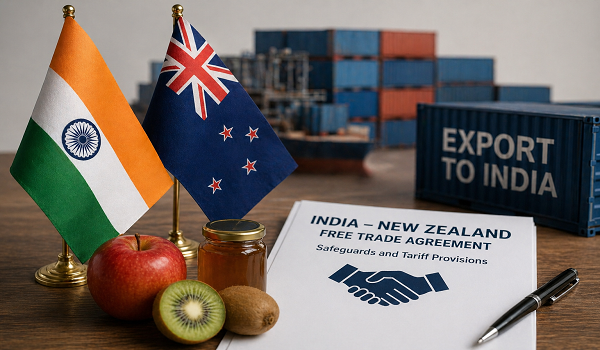
India has incorporated conditional safeguard provisions in its proposed free trade agreement (FTA) with New Zealand, allowing it to suspend tariff reductions on apples, kiwifruit, and honey if agreed cooperation and investment commitments are not met. The clause, included under Annex 2B of the Trade in Goods chapter, enables India to reverse tariff concessions after consultations between joint committees of both countries. If no resolution is reached, India retains the right to rebalance concessions and temporarily suspend market access granted to New Zealand.
The agreement also links tariff benefits to investment obligations, requiring New Zealand to scale up investments in India to approximately USD 20 billion over 15 years. Failure to meet these targets could lead to suspension of tariff relief, although such measures are expected to be temporary and reversible once compliance is achieved or a mutually agreed solution is reached.
According to New Zealand’s Ministry of Foreign Affairs and Trade, the likelihood of such reversals is considered negligible, with confidence expressed in the implementation of cooperation agreements. The analysis also highlights that New Zealand has secured improved market access conditions for apples, kiwifruit, and honey compared to other exporting nations engaging with India.
Under the proposed terms, India’s existing 50% import duty on apples will be reduced by half immediately for shipments up to 32,500 tonnes, with the quota expanding to 45,000 tonnes over six years. This phased approach balances enhanced market access for New Zealand exporters with safeguards for domestic producers.
Industry stakeholders view the agreement as a combination of trade opportunity and sectoral collaboration. Mike Petersen, Chair of Scales Corporation, noted that the cooperation framework will be administered by NZ Apples and Pears Inc and will include technical exchanges with Indian growers. He emphasized that the agreement is designed not only to enable exports but also to support the development of India’s apple sector, where productivity remains lower compared to New Zealand.
Overall, the agreement reflects a calibrated trade strategy by India—offering market access while retaining policy flexibility to protect domestic interests and ensure that international commitments are met.