

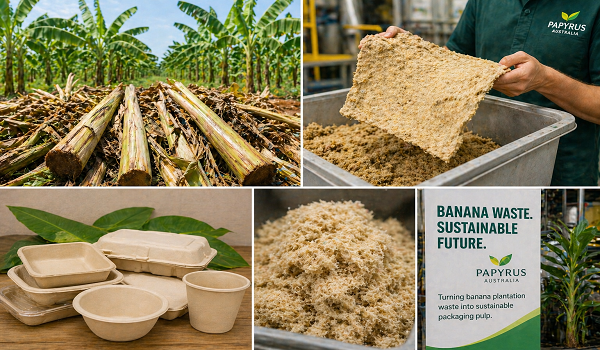
Australia-based Papyrus Australia has developed an innovative technology to convert banana plantation waste into pulp for use in food containers, trays, and packaging materials, offering a sustainable alternative to conventional packaging. The process utilizes banana stalks, leaves, and stems—by-products that would otherwise decompose and release methane emissions equivalent to nearly 900,000 tonnes of carbon dioxide annually.
The technology transforms this agricultural waste into refined pulp suitable for paper, board, and moulded packaging applications. Papyrus Australia is actively collaborating with growers, manufacturers, and packaging converters to scale up the adoption of banana fibre-based materials across industries.
CEO Daniel Schmidt highlighted the commercial and environmental potential of the innovation, stating that businesses with access to banana plantation waste can develop sustainable and profitable manufacturing ventures. He added that the technology presents a global opportunity for the banana industry to better utilize its waste while reducing environmental impact.
In 2025, the company received a US$165,000 matched funding grant under the Australian Government’s Industry Growth Program. The funding has supported early-stage commercialization efforts, including the establishment of a rapid prototyping and R&D facility at Adelaide University. The facility has successfully developed a prototype pulp line and installed equipment to facilitate the transition from research to commercial-scale production.
Papyrus is now working toward setting up a full-scale production facility in Adelaide, which will house its core transformation technology. This plant is expected to play a critical role in scaling the conversion of banana plantation waste into high-value pulp for packaging, paper, and board applications.
Research into banana fibre utilization has been gaining momentum globally. In 2020, the University of New South Wales developed recyclable and biodegradable packaging from banana waste, addressing the inefficiency that only about 12% of the plant is typically used. More recently, banana fibre has also been applied in corrugated packaging solutions, with Zafree Papers and 100+ Accelerator receiving recognition at the Sustainability Awards 2025 for cartons made from banana pseudo stems sourced from Ethiopian farmers.
The development underscores a broader industry shift toward circular economy solutions, where agricultural waste is repurposed into valuable, eco-friendly materials.