

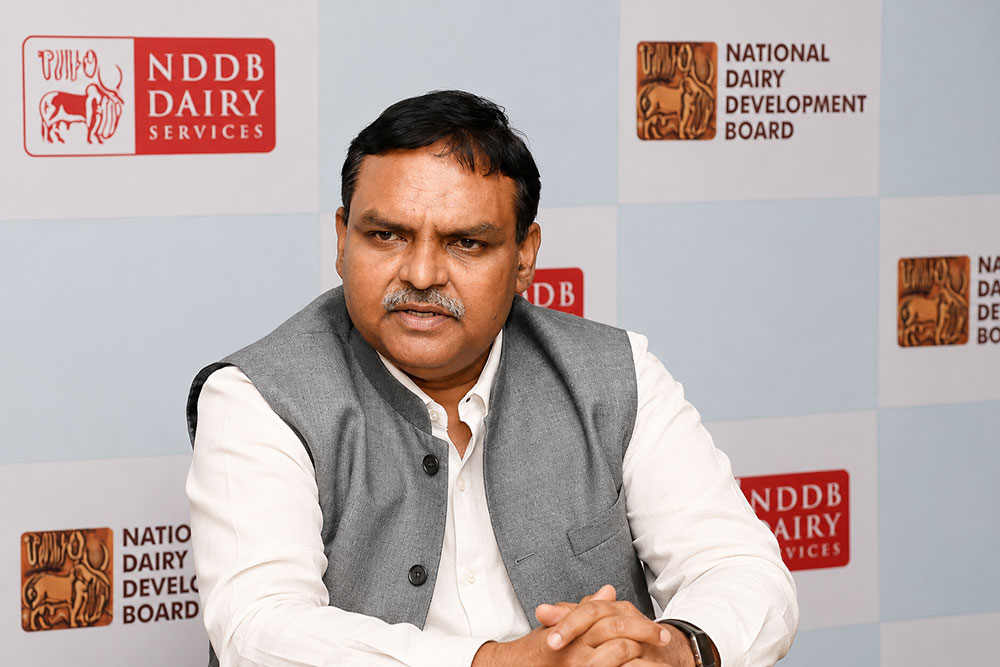
India should continue keeping dairy outside Free Trade Agreements (FTAs) until its millions of small dairy farmers are strong enough to compete with large, heavily supported global producers, according to Meenesh Shah, Chairman of the National Dairy Development Board (NDDB).
Shah said India’s dairy sector supports the livelihoods of more than eight crore families, most of whom operate on a very small scale, typically owning just two or three cattle.
In contrast, dairy farms in developed countries can have hundreds or even thousands of animals and often benefit from significant government support, creating a major cost and scale advantage.
“Generally, our farmers do not get such subsidies. Now think of countries where farms have 1,000-1,500 cows, bringing enormous economies of scale, while various forms of support are also available. We want Indian farmers to first strengthen their assets, increase productivity and become globally competitive,” Shah said during an interaction with the media.
He said this difference in scale and support makes it difficult for Indian dairy farmers to compete directly with imported dairy products if the sector is opened under trade agreements.
India currently has a relatively small presence in the global trade of milk and dairy products because domestic consumption has been growing broadly alongside production.
According to Shah, this means India does not face significant pressure to depend on exports, as most of the milk produced in the country is absorbed by the domestic market.
He also pointed out that Indian consumers receive milk at relatively reasonable prices while dairy farmers receive a comparatively high share of the consumer price.
“If that market is taken over by products coming from other countries, our producers will ultimately suffer. The government understands that this is a real challenge, which is why dairy continues to remain excluded from FTAs,” he said.
While opposing premature exposure of Indian dairy farmers to subsidised global competition, Shah supported stronger competition within the domestic dairy market.
He said the sector should move away from monopolistic structures and encourage competition among cooperatives as well as private dairy companies to improve efficiency, quality and innovation.
“There is no point in having a monopolistic market now. At one stage, the priority was to increase milk availability, and that objective has largely been achieved. Now, to improve efficiency and quality, it is important that the market remains competitive,” Shah said.
He added that dairy cooperatives should be given a level playing field to compete with private companies.
“Players like Amul have already shown that Indian cooperatives can compete with anybody,” he said.
Shah’s comments underline the balancing act facing India’s dairy sector: protecting millions of small producers from unequal global competition while encouraging greater efficiency and competition within the domestic market.