

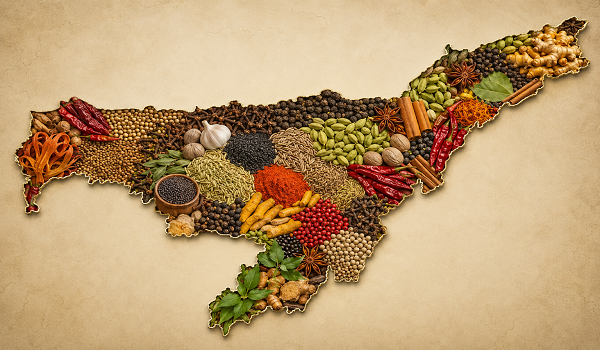
Assam is working on a long-term partnership with Spices Board India to strengthen its spice industry, with the proposed collaboration aimed at improving processing, value addition, and market access and farmer incomes.
The state government is exploring an institutional partnership through a memorandum of understanding (MoU) with the Spices Board. The proposal was discussed during a meeting between Assam Chief Secretary Ravi Kota and Spices Board India Secretary M.S. Manivannan.
The planned collaboration comes as Assam seeks to move beyond the production and sale of raw spices and build stronger value chains around processing, branding and marketing. The state also aims to expand opportunities for local entrepreneurs and improve access to domestic and international markets.
Assam’s large spice base
Assam already has a significant foundation for the proposed initiative. More than 1.08 lakh hectares in the state are under spice cultivation, with production exceeding 4.06 lakh metric tonnes in 2024-25.
Ginger, turmeric, chilli, black pepper, garlic and coriander are among the major spices cultivated in the state. However, officials see scope to increase the economic value generated from this production by improving productivity, quality, storage, processing and market linkages.
The proposed partnership will include region-specific strategies for selected spices, with suitable cultivation areas identified for focused production clusters. Such clusters could provide farmers with access to shared infrastructure, technical assistance, processing facilities and organised marketing networks.
Push for processing and value addition
A key objective is to help farmers and local businesses capture more value beyond the farm gate. Greater investment in cleaning, grading, drying, packaging and other processing activities could create new revenue opportunities while improving product quality and reducing post-harvest losses.
The development of local processing infrastructure could also encourage private investment in food processing, packaging, logistics, storage and distribution, particularly in areas with reliable access to raw materials.
The cultivation of large cardamom in suitable parts of Assam was also discussed. The state is considering practices adopted by other northeastern states, particularly in cultivation and post-harvest management, to assess whether they can be adapted locally.
“The proposed MoU is expected to provide a sustained framework for cooperation between the state government and the Spices Board,” Kota said, adding that the partnership would cover technical support, crop and region identification, capacity building, post-harvest management, processing, value addition and market development.
Building a broader spice economy
For Assam, the proposed partnership represents a broader effort to build an integrated spice economy rather than remain primarily a supplier of raw agricultural commodities.
By combining technical expertise with region-specific production planning, farmer training, processing infrastructure and stronger market connections, the state hopes to create a more commercially sustainable spice ecosystem.
If implemented effectively, the initiative could generate additional income opportunities across the value chain while giving farmers and local enterprises a greater role in higher-value activities. For Assam, the ambition is to turn its existing strength in spice production into a more diversified business ecosystem spanning cultivation, processing and global markets.