

India’s proposed front-of-pack warning label system has triggered opposition from both public health advocates and the food industry, leaving the Food Safety and Standards Authority of India (FSSAI) caught between demands for stronger consumer warnings and concerns that the proposed rules could unfairly stigmatise a wide range of packaged foods.
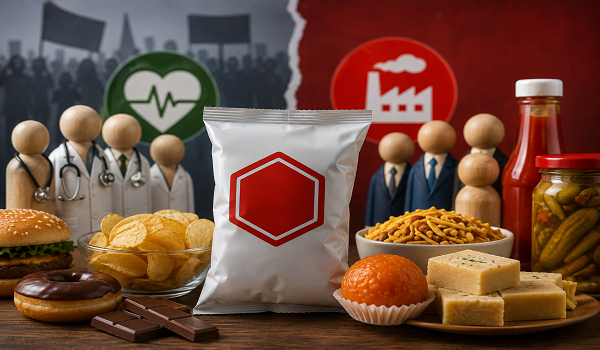
FSSAI has proposed a red hexagonal warning symbol for packaged foods that exceed prescribed limits for two or more of three nutrients — added sugar, salt and saturated fat. The proposal is intended to give consumers a simple, visible indication of foods containing high levels of nutrients associated with health risks. Instead of resolving the long-running debate over front-of-pack nutrition labelling, however, the design has opened up a fresh round of disagreement.
The issue has gained additional attention following reports that the government had earlier softened its position after representations from major food and beverage companies. The matter is also before the Supreme Court, which is hearing a public interest case related to food labelling and is expected to consider FSSAI’s proposal at a hearing on September 10.
Public health researchers believe the proposed system does not go far enough. Their main concern is FSSAI’s requirement that a product must cross the prescribed limit for at least two nutrients before receiving a warning. They argue that a product extremely high in sugar, salt or saturated fat could potentially escape a warning if it remains below the limits for the other two nutrients.
Barry Popkin, professor of nutrition at the UNC Gillings School of Global Public Health, has criticised the double-nutrient approach, arguing that countries using warning-label systems generally assess excessive nutrients individually rather than requiring multiple thresholds to be crossed.
Chile, which introduced its prominent front-of-pack warning system in 2016, places separate black warning symbols on products for individual nutrients that exceed specified limits. Published research on the Chilean system has linked the policy to a decline of roughly 24% in purchases of sugary drinks during the first 18 months, making it one of the most closely watched examples of warning-label regulation globally.
Health advocacy groups have also questioned possible exemptions for products such as honey and jaggery. They argue that exemptions based on a product’s traditional or natural positioning could weaken the effectiveness of a system intended to help consumers quickly identify foods containing high levels of sugar.
The food industry, however, is raising almost the opposite concern. Manufacturers argue that the proposed thresholds and the method used to calculate them could result in warnings appearing on an excessively large number of packaged foods, including products normally consumed in very small quantities.
A major point of contention is the proposal to assess nutrient levels per 100 grams of a product rather than according to a typical serving. Industry representatives argue that this approach can distort the way consumers perceive products such as pickles, sauces and ketchup, which are generally consumed in portions far smaller than 100 grams. Companies are therefore expected to press for greater consideration of realistic serving sizes while finalising the regulations.
Manufacturers have also expressed concern about the proposed nutrient thresholds, including limits for added sugar and saturated fat. They fear that if the cut-offs are set too low, warning symbols could become so common across packaged food categories that they lose their ability to distinguish products with particularly high nutrient levels.
The debate has particular significance for India’s traditional sweets and namkeen sector, where sugar, salt and fat are integral to many established recipes.
Firoz Naqvi, Director General of the Federation of Sweets and Namkeen Manufacturers (FSNM), which represents around 5,000 businesses, said the industry is “deeply concerned” about the implications of the proposed framework. He warned that a substantial proportion of packaged traditional sweets and namkeen could end up carrying warning labels even though products such as mithai are typically consumed in relatively small portions.
Naqvi also cautioned that prominent red warnings could influence how consumers perceive traditional foods and potentially affect demand, making the way serving size and consumption patterns are treated particularly important for the sector.
The disagreement leaves FSSAI with a difficult balancing act. Health groups want a tougher system in which excessive sugar, salt or saturated fat can independently trigger a warning, while manufacturers want thresholds and calculations that better reflect actual consumption patterns and serving sizes.
Several multinational food companies have publicly supported science-based nutrition labelling in principle and indicated that they will comply with the regulations India eventually adopts, while also stressing that formulations, ingredients and consumer preferences differ across markets.
With the proposal now facing scrutiny from both sides and the issue returning to the Supreme Court, the next phase of the debate is likely to focus less on whether India needs clearer front-of-pack nutrition information and more on how strict, scientifically appropriate and practical the final warning-label system should be.