

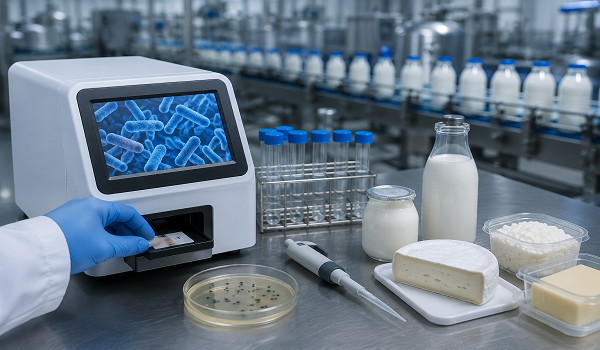
For dairy processors, a positive Listeria test result is rarely a simple lab finding — it sets off a cascade of urgent questions about containment, spread, and whether production can safely resume. Increasingly, the industry is turning to faster detection technologies to close the gap between sampling and action, an interval that food safety experts say can determine whether a contamination event stays contained or escalates.
Why Listeria remains a persistent threat
Listeria monocytogenes poses a disproportionate public health risk despite being less common than other foodborne pathogens. The World Health Organization has reported mortality rates for listeriosis ranging from 20 to 30 percent, with pregnant, elderly, and immunocompromised individuals facing the highest risk.
The organism’s danger lies partly in its resilience. It can survive and grow in refrigerated environments, moist surfaces, equipment crevices, and areas with accumulated residue — meaning that even after pasteurization eliminates it from a product, contamination can be reintroduced later in the production environment through contaminated surfaces or handling practices.
Biofilm formation compounds the challenge. Once Listeria colonies establish themselves on equipment surfaces, they become significantly harder to eliminate through standard sanitation, often leading to recurring contamination in the same locations.
The limits of traditional testing
Culture-based testing has long been the industry standard for confirming Listeria contamination, but the process is slow. It typically involves an enrichment phase to recover low-level or stressed cells, followed by selective plating and confirmation — a sequence that can take four to five days to produce final results.
That delay creates real operational pressure. Processors must make decisions about product holds, sanitation, and production schedules while awaiting confirmation, often without a complete picture of the risk they’re managing.
Faster tools entering the field
A range of newer technologies is narrowing that window. Molecular methods — including PCR, quantitative PCR, multiplex PCR, isothermal amplification, and nucleic acid-based lateral flow assays — detect genetic markers specific to Listeria, cutting detection time relative to conventional culturing. Emerging CRISPR-based platforms are also drawing interest for their ability to pair precise target recognition with rapid signal output.
Immunological methods, including lateral flow immunoassay strips, offer another route to faster preliminary screening, though very low contamination levels may still require additional preparation steps. Meanwhile, biosensor and nanotechnology-based platforms — using electrochemical, optical, and fluorescence-based detection — are pushing toward smaller, more portable tools that could eventually move testing closer to the production floor rather than relying solely on centralized labs.
Beyond pathogen-specific testing, tools like ATP bioluminescence assays give plants instant feedback on sanitation effectiveness by measuring residual biological material on surfaces after cleaning. Paired with digital monitoring systems that track results over time, these tools help facilities spot recurring problem areas before they turn into larger contamination events.
Monitoring programs remain the backbone of prevention
Industry experts emphasize that faster detection tools are not a substitute for structured environmental monitoring programs (EMPs), which are designed to catch and trace contamination before it reaches finished product. Routine swabbing helps identify high-risk zones, and when a positive result does occur, follow-up sampling can determine whether it’s an isolated event or a sign of a persistent source requiring changes to sanitation or equipment maintenance.
Reliability still a work in progress
Faster does not necessarily mean simpler. Experts caution that low-level contamination, sample interference from fats, proteins or cleaning residues, and the risk of false positives or false negatives all remain challenges for rapid testing platforms. Some methods may also detect genetic material from non-viable cells, complicating efforts to determine whether a finding reflects an active risk. Successful adoption, they note, depends as much on staff training, validation, and sampling strategy as on the speed of the technology itself.
Where the industry is headed
Looking ahead, the sector is shifting toward predictive rather than reactive contamination control. AI-assisted monitoring tools are beginning to analyze environmental testing results, sanitation records, and facility movement patterns to flag recurring risks before they materialize. Sequencing-based surveillance is also helping investigators distinguish between new contamination events and persistent, entrenched strains within a facility.
Still, experts stress that no technology replaces fundamentals. Hygienic facility design, rigorous sanitation, trained personnel, and a strong food safety culture remain the foundation of effective Listeria control — with rapid detection serving as an accelerant for decision-making rather than a standalone solution.