

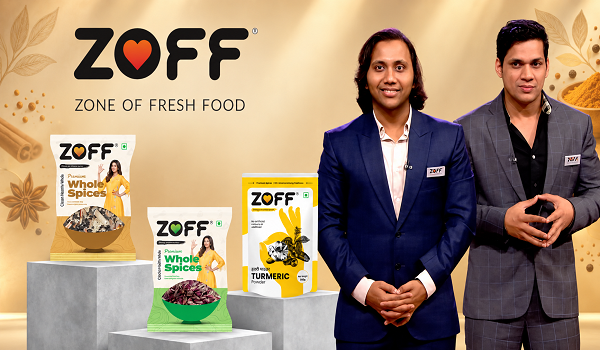
In a country where a bag of spices can be undercut by a rival for the price of a bus ticket, Akash Agrawalla has built a business on a contrarian bet: that Indian consumers, so meticulous when buying a phone or booking a holiday, apply almost none of that scrutiny to what lands in their kitchen.
The co-founder of ZOFF Foods — Zone of Fresh Foods — is capitalizing on a moment. A string of adulteration scandals has rattled India’s spice trade this year, and ZOFF has responded not with a takedown of rivals but with a three-minute film, fronted by chef and creator Natasha Gandhi, that walks viewers through the company’s sourcing, cleaning and cold-grind processing. It is less advertisement than induction video — deliberately slow, deliberately earnest.
Agrawalla is careful to frame the timing as coincidence, not opportunism. ZOFF, he says, had already been campaigning to build awareness of whole spices as a category; the scandals simply made the audience more willing to listen. “Big companies are also facing challenges,” he notes — proof, in his telling, that the adulteration problem isn’t confined to the unbranded corner of the market.
The philosophy: it’s rarely about the price
The campaign’s target isn’t a named competitor, nor even the unorganised trade broadly — it’s a mindset. Agrawalla’s contention is that the price gap consumers are chasing is often trivial: a product he sells for ₹35 might be undercut by just two or three rupees, not the dramatic discounts consumers imagine. Yet that sliver of a difference is often enough to sway a purchase.
The inconsistency, as he sees it, is behavioural. Consumers who research an iPhone purchase for weeks, cross-referencing reviews and specifications, will buy spices — something ingested daily — on price alone, with no equivalent diligence. His ask isn’t that shoppers pay a premium; it’s that they simply know whose product they’re buying and how it was made.
A market still overwhelmingly informal
The numbers underline the scale of the challenge. Whole spices make up three-quarters of ZOFF’s own revenue, yet Agrawalla estimates roughly 90% of that category nationally remains unorganised — a segment where, in his words, consumers have no reliable way to distinguish good product from bad. More broadly, branded spices account for only an estimated 30–35% of India’s total spice market by value, according to IMARC Group, leaving the majority in unbranded hands. Everest, MDH, ITC Aashirvaad, Catch and Badshah remain the dominant national names in the organised segment.
Agrawalla doesn’t expect recent headlines to trigger a mass migration to packaged brands overnight. But he credits the scrutiny with shifting the tenor of the conversation — and argues regulation alone won’t finish the job. Changing decades of habit, he says, requires brands to act alongside government intervention, not wait for it.
Built online, growing offline
ZOFF’s own trajectory mirrors India’s shifting retail map. The brand remains digitally native at its core — 80% of sales still come through online channels — even as it builds out general trade distribution through Kirana Club, a platform connecting retailers directly to stock. Online buyers, Agrawalla argues, exercise more agency, actively searching out and vetting a brand; offline, the retailer often still decides what a shopper walks away with. Notably, he flags a newer signal of interest: a rise in AI-driven search queries around the brand itself.
Marketing spend hasn’t slowed as the company matures — it sits at 17–18% of revenue, funding growth Agrawalla puts at close to 50% year-on-year. Rather than waiting on a dedicated campaign budget, ZOFF has pushed the education film directly onto e-commerce and quick-commerce platforms, with 10–15 shorter cutdowns planned for Instagram and LinkedIn.
For all its pointed messaging, ZOFF is careful to stop short of claiming superiority. The pitch, Agrawalla insists, is narrower than that: not that his spices are better than everyone else’s, but that consumers deserve to know whether any product they buy has been properly screened before it enters their body.