

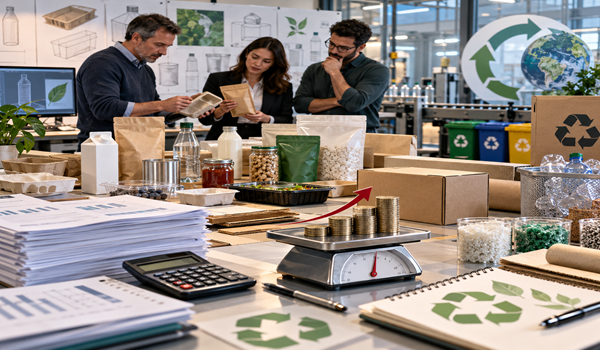
Food and beverage companies can no longer pick packaging on price and shelf life alone. As Extended Producer Responsibility (EPR) laws spread across the United States, brands are being pushed to weigh cost, carbon footprint and regulatory compliance together, according to Tetra Pak executives speaking at a recent Consumer Brands Association webinar.
Packaging has traditionally been judged on product protection, shelf life, cost and consumer convenience. Those factors still matter, but executives say regulatory compliance, recyclability, transportation efficiency and carbon footprint now sit alongside them.
“Previously, we might look at optimizing one objective at a time, but now we have to optimize for several objectives simultaneously,” said Samantha Kappelman, vice president of corporate affairs and public policy for Tetra Pak US and Canada.
What EPR means
EPR is a policy approach that shifts part of the responsibility for collecting, recycling and managing the end of life of products and packaging from governments and consumers to the producers that put them on the market.
Thirty-three states, including Washington, DC, have enacted EPR laws covering various materials. Seven of them, California, Colorado, Maine, Minnesota, Maryland, Oregon and Washington, have passed comprehensive laws that extend to paper and packaging.
Cheap now, costly later
Kappelman warned that packaging that looks inexpensive upfront can turn out to be more expensive once EPR fees and other regulatory costs are counted. She urged brands to evaluate packaging through a total-cost lens.
That means looking at the cost of moving packaging to the facility that fills it and away from it afterwards, along with its carbon footprint, she said.
Recyclable on paper is not enough
Recyclability remains a major pain point. Regulators are increasingly asking whether both virgin and recovered materials can be collected, sorted and recycled at scale, Kappelman said.
She argued that a material being technically recyclable does not count for much if the infrastructure to handle it does not exist. “A package’s potential and its actual pathway can differ by location,” she said.
As EPR programs mature, policymakers are leaning toward packaging formats that already have established collection and recycling systems. In her words, access matters only when a material can actually move through the full system.
Beyond lightweighting
The industry is also focused on using fewer resources, including cutting package weight. But Kappelman said source reduction goes well beyond lightweighting. Companies are examining material choices, package design and transport efficiency as part of broader resource management.
One example is Tetra Recart, a paper-based carton system that can withstand high-temperature sterilization. It is offered as an alternative to metal cans, glass jars and plastic pouches for shelf-stable foods.
The cartons ship flat, so one truck of Recart replaces nine trucks of cans carrying the same quantity, according to Matias Blanco, the company’s US and Canada business development manager.
Blanco noted that while Recart’s laminated lining is technically recyclable, whether it is actually recycled depends on local waste management capabilities. It is recyclable in streams that support Tetra Pak’s portfolio.
Other lightweighting methods include thinner walls and caps on glass, metal and plastic containers, and high-recycled-fibre materials that cut weight without losing strength.
The takeaway
For brands, the message is that packaging is now a system-wide decision. Cost, carbon, logistics and compliance are tied together, and choices made today could shape EPR bills tomorrow.