

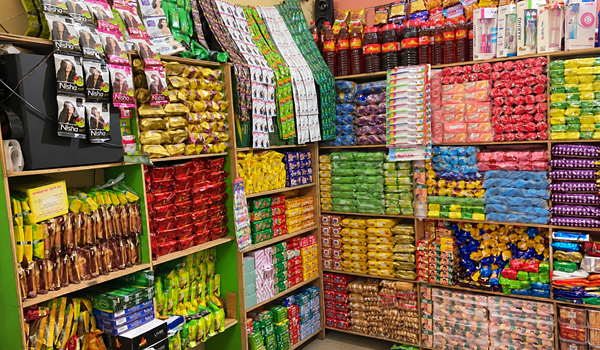
India’s neighbourhood grocery stores are emerging as a new battleground for established fast-moving consumer goods (FMCG) companies and digital-first consumer brands. Once dominated by industry leaders with extensive distribution networks, the kirana market is increasingly making room for younger brands that have built their popularity through online platforms.
New-age consumer brands accounted for 21.7% of India’s kirana market in the first half of FY27, compared with 14.8% during the same period a year earlier, according to data from retail intelligence platform Bizom. The share of established FMCG companies fell from 85.2% to 78.3% over the same period. Bizom tracks around 10 million kirana outlets across India.
The figures indicate a shift in the competitive landscape, as digital-first businesses move beyond e-commerce and quick-commerce platforms to establish a presence in physical retail stores.
Consumer Demand Opens Doors
For decades, large FMCG companies such as Hindustan Unilever (HUL), ITC and Marico have relied on their extensive distribution networks to maintain their market positions. Their ability to reach millions of retailers, replenish stocks regularly and offer dependable supply has given them a significant advantage over smaller competitors.
However, changing consumer preferences are helping new-age brands overcome some of these barriers. Many have built their identities around specialised formulations, premium ingredients, health-focused products and performance-led claims.
Plum Goodness chief executive Shankar Prasad has observed that consumers are showing greater interest in science-backed and clinically positioned products. As shoppers increasingly ask retailers for specific brands, kirana owners are becoming more willing to allocate shelf space to newer entrants.
Quick-commerce platforms have also played an important role. They allow emerging brands to enter multiple cities, test consumer demand and build recognition before investing heavily in traditional distribution.
Distribution Remains the Biggest Challenge
Despite their growing presence, new-age brands still face considerable challenges in expanding across India. Establishing a digital following is different from building a nationwide retail business, particularly in smaller towns and rural markets.
HUL, for example, has more than 3,500 distributors across over 2,000 towns and reaches approximately nine million retail outlets, including three million directly. Such infrastructure takes years to develop and requires substantial investment in warehousing, logistics, sales teams and retailer relationships.
This gap has encouraged established FMCG companies to acquire or invest in digital-first businesses. Over the past five years, HUL, ITC, Marico and Emami have acquired or taken controlling stakes in at least a dozen such brands.
Acquisitions including HUL’s purchase of Minimalist, Marico’s acquisition of Plix and ITC’s acquisition of Yoga Bar illustrate how established companies are using younger brands to reach new consumer segments. In return, these businesses gain access to larger distribution networks, warehouses and marketing capabilities.
Winning Shelf Space Is Only the Beginning
The growing presence of new-age brands does not necessarily guarantee lasting success. Data from Worldpanel by Numerator’s Brand Footprint India 2026 report showed that 56% of brands with low consumer penetration increased their reach in 2025, compared with 83% of brands that already had high penetration.
For smaller businesses, maintaining sales momentum involves managing inventory, ensuring regular deliveries and absorbing distribution costs. Higher retailer margins alone cannot guarantee continued shelf space if products fail to sell consistently.
Established FMCG companies also have the financial strength to improve their supply chains, strengthen retailer engagement and respond to emerging competition.
Nevertheless, the shift in kirana stores signals a significant change in India’s consumer market. Digital-first brands are no longer confined to online shopping platforms. Their growing offline presence suggests that established FMCG companies must compete not only on distribution and price but also on innovation, product differentiation and changing consumer expectations.