

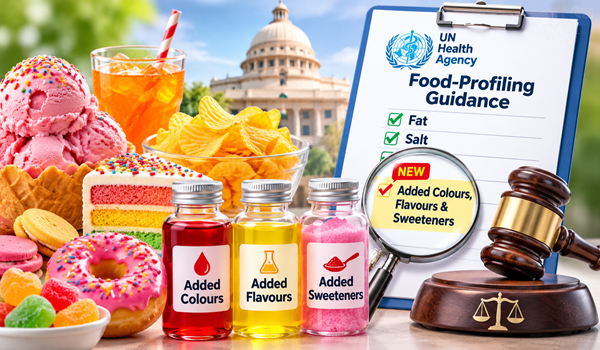
For the first time, the WHO’s food-scoring model includes added colours, flavours and sweeteners, which could lead to warning labels or taxes.
The World Health Organization wants governments to look beyond the nutrition label. Under new draft guidance, how a food is made, including additives used to make it more appealing, could also count. Big food companies were quick to object.
The draft, published last week, says governments should consider regulating foods that contain added colours, flavours or sweeteners meant to make products more attractive to buyers. This is the first time the UN health agency has included such ingredients in its food-profiling guidance. Until now, the guidance looked only at nutrients such as fat and salt.
Public comments on the proposal are open until November 27.
What the model does
The model is meant to help governments decide which factory-made foods should be eaten only in moderation. Depending on each country’s priorities, those foods could then face warning labels or taxes. The WHO describes the model as a link between its healthy-diet advice and actual policy on individual products.
Katrin Engelhardt, a technical officer in the WHO’s nutrition and food safety department, said the draft recognises that a food’s ingredients and how it is made, not just its nutrients, can matter for preventing diet-related disease.
The stakes are high. The WHO links about 11 million deaths a year to unhealthy diets, based on data from a global study.
The ultra-processed food debate
The draft is also the WHO’s attempt to guide countries through the growing argument over ultra-processed foods (UPFs). These are foods and drinks made with industrial processes, additives and ingredients, and they often contain little whole food. Soft drinks and instant noodles are common examples.
Many food scientists say UPFs carry a range of health risks. The industry and some experts argue the category is too broad and could unfairly label healthy products as bad.
Industry pushback
The International Food and Beverage Alliance (IFBA), which represents major multinational food and drink companies, said the WHO approach moves the focus away from nutritional quality and could bring more products under regulation. IFBA Secretary General Rocco Renaldi warned it could weaken existing nutrition goals and the work companies have done to reformulate products.
Companies have other worries too:
- the cost of changing recipes
- stricter labelling rules
- the risk of class-action lawsuits, like those seen in the United States
- higher taxes on processed foods
Kraft Heinz CEO Steve Cahillane told Reuters last week that food companies care about their customers and should have “a seat at the table” as the rules take shape.
Experts back the approach
Lindsey Smith Taillie, co-director of the Global Food Research Program at the University of North Carolina at Chapel Hill, said the model is meant to target unhealthy food using both nutrients and processing. She said the two ideas have always worked together, that healthiness should be judged on several measures, and that policymakers should use both as their starting point.
The WHO is changing how the world decides whether a food is unhealthy. The question is no longer only what a food contains but also how it was made to taste so good. The industry has until November 27 to make its case.