

Prime Minister Narendra Modi emphasised the need for agricultural modernisation, crop diversification and greater use of technology to improve farmers’ incomes and strengthen India’s agricultural economy.
Addressing the Kisan Tak Bharat Agriculture Conference 2026, Modi said the future of Indian farming depended on higher productivity, innovation and value addition. He encouraged farmers to explore opportunities beyond traditional crops such as wheat, rice and sugarcane.
Highlighting India’s agricultural achievements, the Prime Minister stated that annual agricultural exports had crossed Rs 4 lakh crore. He noted that India remained the world’s largest milk producer, while significant progress had also been achieved in horticulture, fisheries, poultry and honey production.
According to Modi, milk production has increased by nearly 70 per cent over the past decade, while egg production has risen by around 90 per cent. Fish production has more than doubled, and horticulture output has increased from 280 million tonnes to over 350 million tonnes.
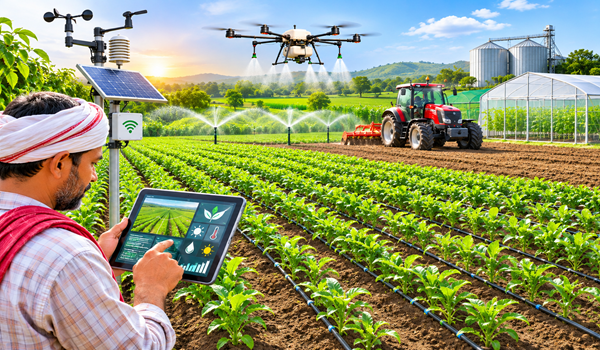
Technology adoption formed another important part of his address. He highlighted the growing use of agricultural drones, artificial intelligence, affordable machinery and sensor-based technologies to reduce cultivation costs and improve farm efficiency.
The Prime Minister also referred to the PM-KUSUM scheme, under which nearly 12 lakh solar pumps have been provided to farmers, helping reduce energy expenses.
Emphasising value addition, Modi encouraged farmers to participate in food processing, marketing and exports. He highlighted the role of 10,000 Farmer Producer Organisations in improving market access and strengthening the bargaining power of small farmers.
He also reiterated the government’s commitment to affordable fertilisers, scientific farming practices and improved agricultural infrastructure.
Concluding his address, Modi said agricultural growth must translate into better livelihoods, stronger rural economies and greater opportunities for farmers. He expressed confidence that innovation, diversification and modern farming practices would contribute significantly to India’s vision of Viksit Bharat.