

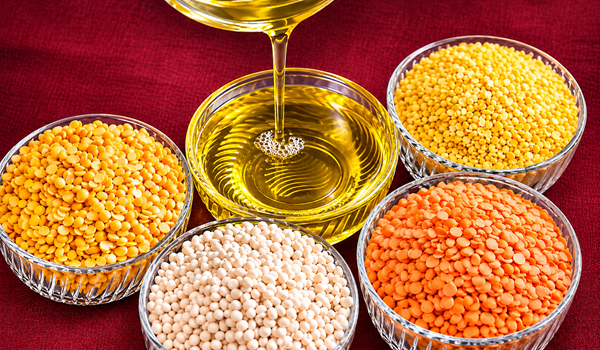
India’s growing dependence on imported edible oils and pulses has raised concerns over the country’s long-term food security, with NITI Aayog Vice-Chairman Ashok Kumar Lahiri calling for increased domestic production and greater crop diversification to reduce vulnerability to international supply disruptions.
Speaking at an event in New Delhi on November 13, Lahiri pointed out that India continues to be the world’s largest importer of edible oils, meeting more than half of its domestic requirements through overseas purchases. Annual edible oil imports are estimated at approximately 17 million metric tonnes, valued at around US$20 billion.
Despite being the world’s largest producer and consumer of pulses, India also depends on imports to meet its requirements. The country accounts for nearly one-fourth of global pulses consumption, estimated at 25–27 million tonnes annually.
Lahiri highlighted that several commonly consumed pulses are sourced from international markets. Chana, or gram, is imported from Australia, while masoor dal comes from Australia and Canada. Other varieties are sourced from Myanmar, African countries and Russia.
Similarly, India’s edible oil supplies depend on countries including Indonesia, Malaysia, Argentina, Brazil, Russia and Ukraine. Such dependence exposes the domestic market to fluctuations in international commodity prices, geopolitical developments and possible disruptions in global trade.
Lahiri observed that essential food items such as pulses and edible oils form an important part of everyday Indian meals. Any major interruption in their availability or sudden price increase could have serious consequences for consumers and the broader food economy.
He stressed that achieving India’s vision of Viksit Bharat by 2047 would require greater attention to agricultural self-reliance, particularly in commodities that remain heavily dependent on imports.
As a possible solution, Lahiri advocated diversifying agricultural production beyond the traditional dominance of wheat and paddy. Encouraging farmers to cultivate more pulses and oilseeds could help increase domestic availability while supporting sustainable agricultural practices.
He also pointed out that pulses and oilseed crops generally require less water than many conventional crops, making their cultivation particularly relevant in regions facing water-related agricultural difficulties.
Alongside increasing production, Lahiri emphasised the importance of reducing wastage throughout India’s agricultural sector.
His observations underline the need to strengthen domestic supplies of essential food ingredients, reduce exposure to global market uncertainties and develop a more resilient agricultural economy capable of meeting the country’s growing consumption requirements.