

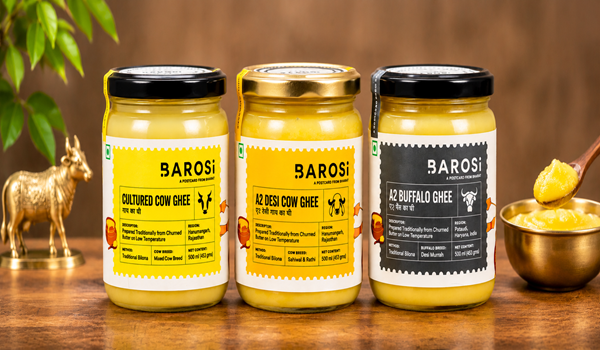
The A2 ghee brand is listed in 98% of Blinkit’s dark stores and has grown without outside funding. Its founder wants five-fold growth in five years.
Barosi began as a small farm-to-home milk subscription service. Today it is one of the most visible premium ghee brands on India’s 10-minute delivery apps. The company closed FY26 with revenue of ₹56 crore and now has an annualized revenue run rate of ₹180 crore, or about ₹15 crore a month. It has reached that scale without raising any external capital.
Founder Durlabh Rawat is now aiming much higher. “We have set our sights on growing more than 5X in yearly ARR to ₹1,000 Cr in the next five years,” he said.
Village roots, corporate exit
Rawat grew up in a modest home in a village in Uttar Pradesh, where the family kept two cows and a goat, Inc42 reported. After a diploma in engineering, he worked at Mahindra & Mahindra and then left to start a dairy business. His parents first objected that he was returning to the life he had tried to escape, but his conviction eventually won them over.
Barosi launched in 2016 in Gurugram, delivering fresh milk from its Pataudi farm the next morning. In 2019, Syed Shamoail Haque joined to build the brand online and later became cofounder in charge of digital growth.
Finding a hero product and a door into quick commerce
The founders picked premium A2 cow ghee as their flagship. It was already selling well on Barosi’s website and Amazon, but quick-commerce platforms doubted that shoppers would buy expensive ghee on a 10-minute app, and Barosi’s pitches went nowhere.
That changed after Barosi appeared on Shark Tank India in February 2023. Blinkit founder Albinder Dhindsa then announced that the platform would onboard brands featured on the show. Barosi got a Blinkit listing in April 2023, was moved to the platform’s main board, and added Instamart in June and Zepto in December. Within about eight months of its Blinkit debut, it had crossed ₹1 crore in monthly quick-commerce sales.
Rawat said a distinctive product, a strong brand story and good timing all helped, and that the goal was to widen reach rather than reinvent the product.
The cost of 10-minute shelves
Quick commerce has not been cheap for Barosi. Rawat said newer brands pay far steeper margins than established FMCG names, with Blinkit taking at least 25% on average while legacy players like Amul or ITC give single digits. Barosi stopped supplying some platforms that discounted its products too heavily. Rawat considers a 10–15% discount fair, split roughly 7–8% from Barosi and 5–6% from the platform.
An analysis by Zodiac AI by Nitro Commerce found that Barosi kept average on-shelf availability of 94.7% on Blinkit between October 31 and November 3, 2026.
Bigger baskets, smaller cities
Barosi started on quick commerce with 500 ml and 1-litre ghee packs, and the 1-litre pack is still its bestseller. The range has grown to about 25 SKUs, including oils. A 5-litre tub, listed on Blinkit at the platform’s request, became a surprise hit, which suggests shoppers also use these apps for planned, larger purchases.
Average order value is about ₹1,100, with quick commerce adding ₹200–300 more. Between 20% and 22% of quick-commerce customers buy again in the first month, rising to about 28% by the second. Tier II cities now make up about 40% of sales, led by Lucknow, Jaipur and the Chandigarh–Panchkula–Mohali region. Barosi has deliberately stayed out of offline retail, which Rawat says would demand too much energy and capital.
Spreading the risk
Blinkit, Instamart and Zepto once made up almost all of Barosi’s business. They now account for about half. Amazon Now and Flipkart Minutes have become its second- and third-largest channels, together contributing about 23% of revenue. BigBasket and FirstClub are also growing. “If we divide our dependence on three quick commerce channels, our risk will be optimised,” Rawat said.
Revenue has grown from about ₹11 crore in FY24 to ₹32–34 crore in FY25 and ₹56 crore in FY26. Barosi reported a profit-after-tax margin of 2–3% in FY26, which Rawat expects to rise to 8–9% this year. The company has about 70 employees and nearly 100 off-roll plant workers. Exports are its priority this year, and a new product range is on the way.