

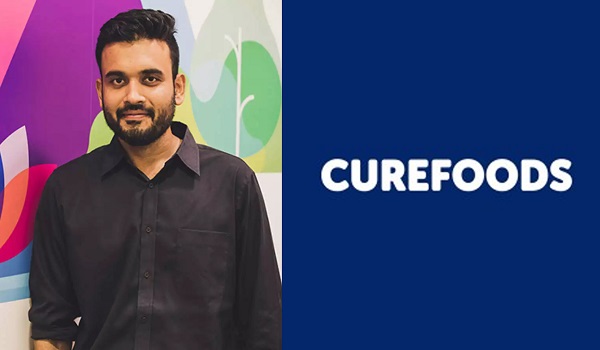
Curefoods is broadening its food services portfolio with new ventures in fried chicken, premium ice cream and budget coffee as the company prepares for its stock market debut next year.
The food-tech company, founded by Ankit Nagori, has received approval from the Securities and Exchange Board of India (SEBI) and is expected to list in the second quarter of the next financial year. Ahead of the IPO, Curefoods is repositioning itself from a delivery-focused cloud kitchen operator into a diversified multi-brand food platform with a stronger physical retail presence.
The expansion comes at a time when India’s quick-service restaurant (QSR) industry is navigating a slowdown marked by rising real estate costs and higher customer acquisition expenses. Despite these challenges, Curefoods is pushing ahead with category expansion and store growth.
The company expects to close the current fiscal with 25–30% year-on-year growth. Its pizza brands Olio and Nomad Pizza have emerged as among its fastest-growing segments and are projected to become a ₹500-crore business by FY28.
Meanwhile, the biryani brand Sharief Bhai Biryani has crossed around ₹175 crore in annual revenue and is expanding further into southern markets, including tier-2 cities.
Nagori said two of the company’s major priorities this year are strengthening its dessert portfolio and expanding its pizza business.
Krispy Kreme expansion drives offline growth
A key pillar of Curefoods’ strategy is the expansion of Krispy Kreme, for which it holds pan-India franchise rights. Within a year of acquiring the franchise, the company has scaled the doughnut chain to more than 100 outlets across NCR, Jaipur, Chennai, Hyderabad and Bengaluru.
Locations such as airports and large shopping malls are emerging as major growth drivers, with new launches planned in Chandigarh, Pune and Mumbai.
The expansion also marks a strategic shift for Curefoods toward offline retail. Initially built on a cloud kitchen model during the delivery boom, the company is now seeking to balance its channel mix as delivery economics tighten.
“Customer acquisition costs are at an all-time high,” Nagori said, noting that Curefoods plans to generate about 50% of its revenue from direct channels by FY28, with nearly 80% of that expected to come from physical stores.
Krispy Kreme kiosks are leading this shift, particularly in airports and tech parks. Coffee sales have emerged as an important contributor, accounting for about 15% of kiosk revenue. With beverages priced from ₹69 and combo offers starting at ₹99 in office clusters, the company is positioning coffee as an affordable, high-frequency purchase.
New bets on chicken and ice cream
Alongside scaling existing brands, Curefoods is entering two high-growth categories: fried chicken and premium ice cream.
The company has launched PHAT (Pretty Hot And Tempting), an in-house fried chicken brand aimed at consumers aged 15–25. The brand will feature Korean-inspired flavours, digital-first marketing and pricing slightly below established chains.
Nagori said the organised fried chicken market in India runs into several thousand crores and that capturing even 5% of the segment could help build a ₹500-crore brand.
Curefoods is also expanding in desserts through PapaCream, a premium ice cream concept for which the company holds pan-India franchise rights. Positioned around indulgent sundae formats rather than mass-market flavours, PapaCream is already available through more than 50 cloud kitchens and is expected to expand to 100–150 locations by the end of the year.
The brand is targeting a ₹50-crore run rate next year and ₹100 crore in the following year.
Growth amid sector headwinds
The company’s expansion strategy comes as the QSR sector faces a prolonged slowdown driven by inflation, changing consumption patterns and cautious spending by younger consumers.
Nagori said the industry slowdown has persisted for nearly three years and may reflect deeper structural shifts rather than a purely cyclical downturn.
As Curefoods approaches its IPO window, investors are likely to closely evaluate store-level profitability, unit economics and capital discipline as the company scales new categories while building a stronger offline presence.