

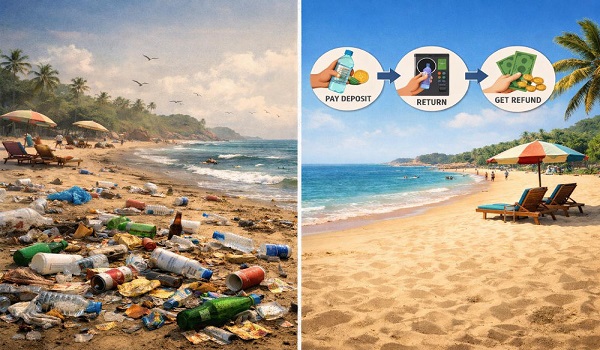
The Goa government’s decision to roll out a Deposit Refund Scheme (DRS) from April 1, 2026, has drawn sharp reactions from the food and FMCG industry, which has flagged concerns over higher consumer costs, operational complexity and duplication of existing waste management regulations.
Under the proposed scheme, consumers—including both Goans and tourists—will be required to pay an additional deposit on everyday food and beverage items sold in plastic and glass packaging such as bottles, pouches, multilayered wrappers and cartons. The deposit, ranging from ₹2 to ₹10 per pack, will be refunded digitally once the empty packaging is returned to designated collection centres.
Industry stakeholders have cautioned that the scheme places a disproportionate burden on consumers, who will now be required to store used and often unhygienic packaging and travel to collection points to claim refunds. Concerns have also been raised about the adequacy and accessibility of collection centres, particularly for rural and semi-urban consumers, increasing the likelihood of deposit forfeiture.
Another key issue highlighted is the potential for double-charging. Goans already pay periodic household waste management fees, and the introduction of DRS would effectively make consumers pay twice for managing the same waste stream, industry representatives said.
The FMCG sector has also questioned the rationale behind introducing DRS in a state that already has a well-functioning waste management ecosystem. Goa has an established system of door-to-door waste collection, segregation, composting and recycling, and its cities were recognized at the national level in the Swach Survekshan 2024–25 Awards. Industry bodies argue that India also has sufficient recycling capacity to manage plastic, metal and glass waste under existing frameworks.
From a regulatory standpoint, companies have pointed out that the FMCG industry is already compliant with the Plastic Waste Management Rules and extended producer responsibility (EPR) norms at the national level. The introduction of a state-specific deposit system, they say, amounts to regulatory duplication and adds complexity across the supply chain. The FMCG sector, valued at around ₹21 lakh crore, is a significant contributor to Goa’s economy.
Stakeholders have further expressed concern that the scheme was introduced without comprehensive scientific or technical evaluation and without adequate consultations with local bodies, consumers, retailers, waste pickers, recyclers, waste management agencies or industry and environmental experts.
The exemption of microenterprises from the scheme has also raised questions about its effectiveness in reducing littering, with industry players warning that it could distort competition in highly price-sensitive categories such as packaged snacks, bottled water, soft drinks and juices.
Citing design and implementation gaps that could disrupt market dynamics and inconvenience both residents and tourists, industry representatives have urged the Goa government to defer the rollout of the Deposit Refund Scheme. They have called on the state to constitute a joint working group comprising industry associations, consumer representatives, local bodies and technical experts to reassess the framework before implementation.