


Lapses have surfaced in the implementation of GST 2.0 benefits across FMCG products, sparking a blame game between companies and distributors. The government is now preparing to take action against firms and e-commerce platforms accused of not passing on tax reductions to consumers — particularly for low-value packs priced at ₹20 and below.
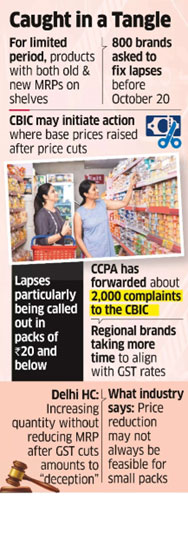
According to officials, the Central Board of Indirect Taxes and Customs (CBIC) has received around 2,000 consumer complaints from the Central Consumer Protection Authority (CCPA) and is examining instances where base prices were raised after the GST rate cut. “There is sufficient provision in the law to initiate action against erring entities,” said a senior government official.
While companies insist that benefits are being passed on, distributors allege that some large FMCG players have selectively increased base prices, negating the intended relief. “Distributors can pass only what shows in the company’s system,” said the head of a major distribution network, who spoke on condition of anonymity. “Some large brands have hiked base prices of select SKUs, so the price drop is not reaching consumers.”
Executives at Hindustan Unilever (HUL), Colgate-Palmolive, Himalaya Wellness, and Perfetti Van Melle have denied any wrongdoing, stating that all applicable GST benefits are reflected in their new price structures. “For a limited period, both old and new MRPs may be available in the market, and consumers are advised to ask for revised MRPs before purchase,” said an HUL spokesperson. The maker of Lux soap and Brooke Bond tea said it has reduced prices or increased grammage to ensure pricing simplicity.
Colgate-Palmolive India managing director Prabha Narasimhan said the company had implemented price reductions effective September 22 and passed full benefits to channel partners. “Consumers should expect to see the new prices on shelves by early November,” she added.
Meanwhile, the Department of Revenue and CBIC are also scrutinizing e-commerce transactions, which account for a large share of consumer complaints. Many shoppers reported that price cuts were not visible on digital grocery platforms. “Most large portals have updated rates in line with the new GST regime, though some issues are product-specific,” said an official aware of the review.
The Centre has issued notices to around 800 brands and companies, directing them to rectify discrepancies by October 20, especially in cases where firms have cited system delays or technical glitches. Industry sources said several regional FMCG brands are still aligning their billing systems to reflect revised GST rates.
With the government tightening its compliance net, both manufacturers and distributors face increasing pressure to ensure that GST 2.0’s intended consumer benefits do not vanish in the supply chain maze.