

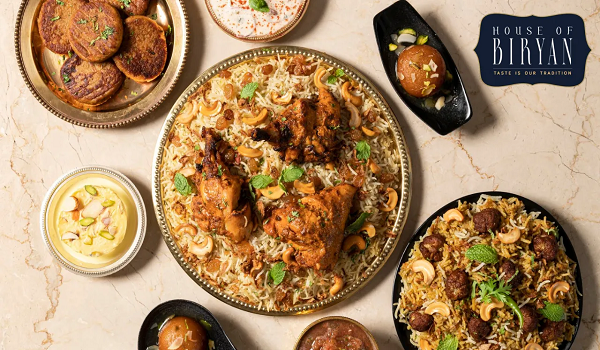
Once a royal delicacy from the kitchens of Awadh, biryani has travelled from slow-cooked dum pots to modern cloud kitchens, and now to automated kiosks. Riding on the enduring popularity of the dish, tech-enabled cloud kitchen brand House of Biryan (HOB) has announced an aggressive expansion plan, targeting ₹300 crore in revenue over the next three years and ₹500 crore within five years, while aiming to achieve profitability in India by the end of calendar year 2026.
Founded in 2022 by Mohammed Bhol and Mikhail Shahani, with Mohit Goyal joining as co-founder in 2025, the brand has rapidly expanded from a single kitchen to 26 outlets, including 21 in India — 11 in Mumbai and 10 in Delhi — and five in Dubai. The company claims to have served more than 10 million biryanis so far.
According to the founders, Mumbai operations are already profitable at the corporate level, while Delhi is nearing city-level breakeven. Overall profitability across India and the UAE is expected by mid-2027.
The company plans to scale to around 70 outlets across Mumbai, Delhi, Pune, the UAE and Saudi Arabia over the next three years, with India and the GCC region remaining its core markets.
HOB expects to close the current financial year with an annualized revenue run rate of ₹55–60 crore. The brand’s average order value in India has grown from ₹450 in its first year to around ₹750, while in the UAE it stands at about 70 dirhams and is expected to rise further as the company deepens its presence.
To improve margins, the company has reduced packaging costs by nearly 17 per cent through strategic partnerships, leading to better operating efficiency in its cloud kitchen model.
Over the past three years, the company has raised around ₹40 crore and is currently in the process of raising an additional $4 million to fund expansion in India and the Gulf markets.
As part of its innovation-led growth strategy, the company is piloting automated biryani kiosks in Dubai, with plans to deploy 50–60 machines this year. Each kiosk requires significantly lower investment compared to a full cloud kitchen, allowing the brand to expand in high-density office and commercial locations.
HOB is also working on ready-to-eat and heat-and-eat packaged formats, which are expected to be launched within the next few quarters as the company looks to enter the FMCG segment and cater to multiple consumption occasions.
Currently, biryani contributes about 65 per cent of total revenue, followed by kebabs at around 15–18 per cent, with the rest coming from rolls, curries and desserts. The brand offers nearly 60 SKUs, with around 30–35 core products.
Looking ahead, the company plans to enter new international markets such as Australia, Japan, the UK and North America over the next five years, though the founders say their immediate focus is on strengthening supply chains and building scale in existing markets.
The company also plans to introduce dine-in experience centres once it reaches an annual revenue run rate of ₹150 crore.
In a major brand-building move, former Indian cricket captain Mahendra Singh Dhoni has expanded his association with the company from investor to official brand ambassador and has also increased his stake in the latest funding round. The brand is backed by a mix of celebrity and institutional investors, including Shardul Thakur, Rannvijay Singha, Amol Parashar, Al Siraj Holdings and Angel Star Ventures.
With traditional flavours meeting technology-driven delivery formats, House of Biryan is betting that India’s love for dum-cooked biryani can power the creation of a global food brand.