

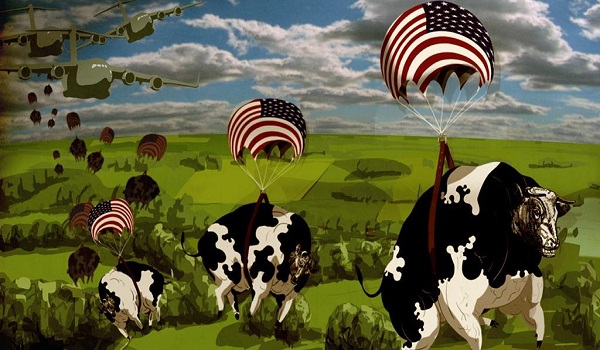
India’s powerful farming community has raised the alarm over trade talks with the United States, warning that the livelihoods of millions of dairy farmers could be at stake. In a strong show of resistance, the Bharatiya Kisan Union (BKU), one of the country’s most prominent farmers’ organizations, has announced a nationwide call to boycott U.S. goods if the proposed free trade agreement between New Delhi and Washington allows duty-free entry of American dairy products.
The BKU argues that India’s dairy industry, which is the backbone of rural livelihoods, faces a severe threat from the potential influx of cheap U.S. dairy imports. Unlike India’s fragmented sector—comprising mostly smallholder farmers and cooperative models—American dairy farms operate on a massive industrial scale, enabling them to produce milk and dairy products at a far lower cost. Indian farmers fear that once these low-cost imports enter the market, local producers will be unable to compete, leading to widespread losses and a breakdown of rural economic stability.
“Dairy is not just a product for us; it is the heartbeat of rural India,” a BKU spokesperson declared. “If the government signs a deal that allows unrestricted imports, it will destroy the very foundation of our rural economy.”
India is the world’s largest milk producer, with over 80 million rural households engaged in dairy farming. The sector provides direct and indirect employment, especially to women in villages, and plays a crucial role in ensuring food security. Farmers point out that the proposed trade deal risks not just an economic setback but also long-term damage to India’s self-reliance in food production.
The boycott call, experts say, is both an economic protest and a political signal to the government. India’s farmers have a history of mounting large-scale mobilizations against policies perceived as harmful—from past protests over agricultural laws to current resistance against international trade compromises. This latest move signals that any agreement jeopardizing India’s dairy sector could trigger a wave of unrest and nationwide demonstrations.
For policymakers, the issue represents a delicate balancing act. On one hand, free trade advocates argue that opening up to U.S. products could benefit Indian consumers through lower prices and diversified options. On the other hand, dairy economists and farmer leaders emphasize that the “cheaper” cost comes at a much higher price—loss of rural livelihoods, weakened cooperatives like Amul, and erosion of India’s food sovereignty.
The dispute also carries international implications. It highlights how trade deals are no longer just about tariff negotiations but about navigating the intersection of global commerce, local livelihoods, and political sensitivities. The outcome of the India-U.S. talks will be closely monitored worldwide as a case study of how developing nations balance economic diplomacy with protecting critical domestic industries.
As of now, the farmers’ boycott threat stands as a bold warning: if cheap U.S. dairy floods Indian markets, the backlash may extend far beyond the fields and milk parlours—reshaping India’s political and economic landscape in the process.