

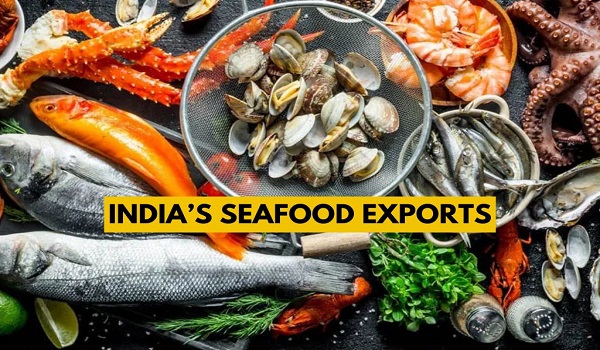
India’s seafood exports to the United States — its largest overseas market — have fallen by nearly 6% following steep new tariffs, prompting urgent calls from industry leaders and policymakers for market diversification, value addition, and technology-driven innovation to safeguard the sector’s growth.
The issue took center stage at an industry meet held alongside the 4th International Symposium on Marine Ecosystems (MECOS 4) at the ICAR–Central Marine Fisheries Research Institute (CMFRI) in Kochi. Stakeholders warned that without swift corrective measures, India risks losing its competitive edge in the global seafood trade.
According to government data, India exported 1.7 million tonnes of seafood worth ₹62,408 crore ($7.45 billion) in FY 2024–25. The US remained India’s top buyer with imports worth $2.71 billion, followed by China ($1.27 billion), the European Union ($1.12 billion), and Southeast Asia ($975 million).
However, the recently imposed tariffs — comprising 5.76% countervailing duties and 3.96% anti-dumping duties — have raised the effective duty burden to nearly 59%, making Indian seafood exports to the US largely unviable. “Combined with anti-dumping and countervailing duties, the effective tariff now stands at 58.26%, severely denting India’s competitiveness in its top export destination,” said Ram Mohan, Director, Marine Products Export Development Authority (MPEDA).
Despite the slump in the US market, exports to China, Vietnam, and Thailand have shown robust growth, signaling a potential shift toward Asian markets.
Industry experts at the meet emphasized the need to move beyond bulk raw exports and focus on value-added seafood products such as breaded squid rings, surimi-based items, and ready-to-eat fillets. “A robust, technology-driven startup ecosystem in the fisheries sector is vital to drive innovation and value addition,” said Dr. George Ninan, Director of the ICAR–Central Institute of Fisheries Technology (CIFT).
India’s current value-added seafood exports stand at just $742 million, far behind competitors like China, Thailand, Vietnam, Ecuador, and Indonesia. The industry has called for exclusive aquaculture zones, faster Free Trade Agreement (FTA) negotiations, and government-backed incentives to restore global competitiveness.
A.J. Tharakan, President of the Seafood Exporters Association of India (SEAI), cautioned that the new tariff regime has “disrupted shrimp exports — the backbone of India’s seafood trade — and impacted overall export earnings.”
To counter the fallout, the government is pushing for market diversification. Fisheries Minister Rajiv Ranjan Singh Lalan recently highlighted untapped opportunities in the EU, Russia, and Middle East, noting that India’s seafood export story must “move up the value chain to stay resilient in a changing trade environment.”