

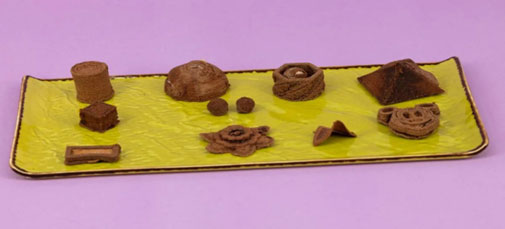
Italian scientists are developing next-generation snacks made from lab-grown plant cells and agri-food by-products, using 3D printing technology to create nutrient-rich pastries designed for a future shaped by climate change and shrinking farmland.
The research is being led by Nutri3D, a project of Italy’s public research agency ENEA, which is exploring ways to preserve taste and nutritional value while rethinking how food is produced. The initiative combines plant cell cultures with fruit residues from food processing to create printable “inks” that can be shaped into snack bars and confectionery-style products.
Prototypes unveiled at the EltHub facility in Oricola, Abruzzo, include energy bars and glossy “honey pearls,” developed to maintain flavour while delivering high nutritional density.
“In a world where arable land is shrinking and climate change forces us to rethink food production, the goal is to keep making what we are used to eating,” said Silvia Massa, head of ENEA’s Agriculture 4.0 laboratory. “The aim is not to grow the plant itself, but its cells.”
While Northern European countries have pioneered cellular food research — with Finnish laboratories producing fruit compotes from cell cultures and Zurich-based scientists developing cocoa-like flavourings — the Italian approach adds a culinary twist by integrating recovered by-products from traditional food processing.
“We Italians bring creativity, combining cellular food with recovered by-products,” Massa said, citing fruit residues from jam production as one example.
The Nutri3D project is being carried out in partnership with EltHub, a private Italian technology R&D company within the ELT Group, and Rigoni di Asiago, a family-owned organic food producer.
At the Oricola plant, ENEA’s plant-based materials are fed into 3D printers that shape the snacks layer by layer. An ENEA survey found that 59% of respondents were willing to try foods made using this technology, indicating growing consumer openness to alternative food systems.
Beyond everyday consumption, researchers say the technology could prove valuable in resource-scarce environments, including space missions or conflict zones. EltHub director Ermanno Petricca described the snacks as “fruit for astronauts,” noting their potential for long shelf life and controlled nutrition.
ENEA is also testing microgreens and nano-tomatoes for space cultivation. On Earth, 3D food printing could enable customised nutrition for people with specific dietary needs. Reflecting this shift, a plant-based restaurant in Rome, Impact Food, has already added 3D-printed sliced meat alternatives to its menu.