

Rethinking Cooking Energy in India’s Mithai & Restaurant Kitchens
Across India, the mithai, namkeen and restaurant industry is facing a serious operational challenge—shortage and irregular supply of commercial LPG cylinders. For decades, LPG has been the backbone of cooking operations in halwai kitchens, restaurant kitchens, and namkeen factories. From frying jalebis and samosas to boiling milk for khoa and preparing sugar syrups, LPG burners power almost every essential cooking process.
However, in recent months many cities have reported difficulty in obtaining commercial LPG cylinders on time. Restaurants and sweet shops in several markets have temporarily shut down their kitchens or reduced production due to lack of fuel. For an industry that operates on tight production cycles and peak-hour demand, even a short disruption in cooking fuel can cause significant financial loss.
The current situation has triggered an important discussion across the industry: Is it time to rethink the energy sources used in commercial kitchens?
While LPG will continue to remain an important cooking fuel, there are several alternative energy options available today in India. These include piped natural gas (PNG), electric induction systems, biomass-based heating systems, coal or wood-fired bhattis, and biogas solutions.
Each option comes with different costs, operational characteristics, and installation requirements. Understanding these alternatives is becoming increasingly important for mithai and restaurant operators who want to reduce their dependence on a single energy source.
LPG: The Current Benchmark
Commercial LPG cylinders of 19 kilograms are the most widely used cooking fuel in restaurants and sweet shops across India.
At present, a commercial cylinder typically costs around ₹1,800–₹1,900 depending on the city. In energy terms, one kilogram of LPG provides roughly 12.8 kilowatt-hours (kWh) of heat energy. This means a single cylinder delivers approximately 240 kWh of heat energy.
When converted into usable heat cost, LPG typically works out to about ₹7.5–₹8 per kWh.
A small sweet shop may consume around three cylinders per day, resulting in a daily fuel expense of approximately ₹5,000–₹6,000. Medium-sized restaurants may use five to six cylinders daily, while large halwai kitchens or namkeen factories may consume ten or more cylinders every day.
Given this scale of usage, LPG represents one of the most significant operational costs for the industry. Any disruption in supply immediately impacts production and business continuity.
PNG: The Most Practical Alternative
In cities where pipeline infrastructure exists, Piped Natural Gas (PNG) is emerging as the most practical alternative to LPG.
PNG is supplied directly through pipelines by city gas distribution companies, eliminating the need for storing cylinders or managing frequent deliveries.
Commercial PNG prices generally range between ₹50 and ₹65 per Standard Cubic Meter (SCM). Since one SCM of natural gas provides about 10.5 kWh of heat energy, the effective heat cost works out to approximately ₹5.5–₹6 per kWh, making it slightly cheaper than LPG.
PNG burners also produce a flame-based heat source similar to LPG, making the transition relatively easy for kitchen staff.
The major limitation, however, is availability. PNG networks currently exist mainly in large cities and urban clusters. Many smaller towns and traditional sweet markets do not yet have pipeline connectivity.
Where available, however, PNG offers a reliable and convenient replacement for LPG.
Electric and Induction Cooking Systems
Electric cooking technologies—especially commercial induction systems—are increasingly being discussed as a possible long-term solution.
Commercial induction cooktops used in professional kitchens typically operate between 8 kW and 15 kW capacity and can generate high temperatures rapidly.
However, electricity tariffs for commercial kitchens in India are relatively high. Depending on the state, demand charges, and sanctioned load, commercial electricity costs generally range between ₹14 and ₹15 per kWh.
Even though induction cooking systems operate with high efficiency (around 90%), the effective heat cost still remains in the range of ₹14–₹15 per kWh, which is significantly higher than LPG or PNG.
Electric cooking does offer certain advantages:
• Clean kitchen environment with no combustion fumes
• Faster heating due to direct energy transfer
• Better temperature control
• Reduced ventilation requirements
However, traditional halwai kitchens face some challenges with induction technology. Large iron kadhais used for deep frying may not always be compatible with flat induction surfaces. In addition, induction kitchens require high electrical load connections and stable power supply, which may not be available in older market areas.
For these reasons, electricity is currently best suited for milk boiling, syrup preparation, gravy cooking, and auxiliary kitchen operations rather than heavy frying.
Biomass Fuel Systems
Biomass-based heating systems are among the most economical alternatives to LPG.
Biomass pellets or briquettes made from agricultural waste such as rice husk or sawdust typically cost ₹8–₹12 per kilogram and produce around 4.5 kWh of heat energy per kilogram.
This results in an effective heat cost of approximately ₹2–₹2.5 per kWh, making biomass significantly cheaper than LPG.
Modern biomass systems often use gasifier technology, which converts pellets into combustible gas that can be used in burners or heating systems.
Installation costs vary depending on capacity:
• Small systems: ₹80,000 – ₹2 lakh
• Larger industrial systems: ₹5 lakh and above
Biomass systems are particularly suitable for large namkeen factories or bulk frying operations, where continuous heat is required for long production cycles.
However, these systems require fuel storage space and trained operators, which may not always be feasible in small retail kitchens.
Coal and Wood-Fired Bhattis
Traditional coal or wood-fired bhattis were once the backbone of halwai kitchens across India.
Even today, some sweet shops continue to use these systems for specific cooking processes.
Coal generally costs around ₹10–₹14 per kilogram and produces roughly 7 kWh of heat energy per kilogram, resulting in an effective heat cost of approximately ₹1.7–₹2 per kWh.
The installation cost of a coal-fired bhatti is relatively low, typically ranging between ₹20,000 and ₹70,000.
These systems generate strong heat and are particularly suitable for large iron kadhais used for deep frying.
However, coal and wood-fired systems produce smoke, ash, and emissions, and require constant manual supervision. Increasing environmental regulations in many cities are also discouraging their use.
As a result, they are generally considered backup or temporary solutions rather than long-term options.
Biogas: A Sustainable Option
Biogas systems convert organic waste into methane gas through anaerobic digestion.
One cubic meter of biogas produces roughly 6 kWh of heat energy, and once the system is installed the effective cost of heat can be as low as ₹1–₹2 per kWh.
However, commercial biogas systems require significant initial investment and a steady supply of organic waste.
Small plants may cost around ₹1 lakh, while large installations can cost ₹10–₹20 lakh or more.
For large food campuses or production facilities generating organic waste, biogas can be a useful supplementary energy source.
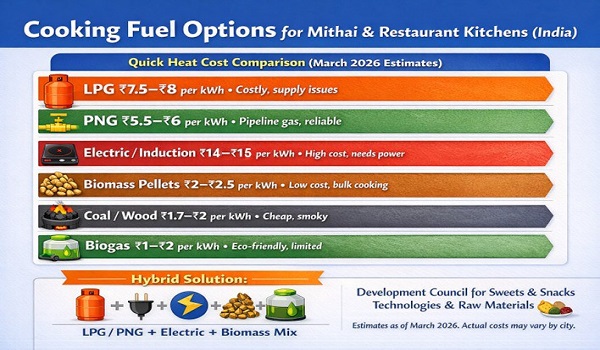
Comparison of Cooking Energy Options (Approx Heat Cost)
Fuel Type Approx Heat Cost
LPG ₹7.5 – ₹8 per kWh
PNG ₹5.5 – ₹6 per kWh
Electric / Induction ₹14 – ₹15 per kWh
Biomass Pellets ₹2 – ₹2.5 per kWh
Coal / Wood Bhatti ₹1.7 – ₹2 per kWh
Biogas ₹1 – ₹2 per kWh
The Future: Hybrid Halwai Kitchens
Energy experts increasingly believe that future commercial kitchens will not depend on a single fuel source.
Instead, many operations may adopt hybrid kitchen models, combining multiple fuels based on cooking requirements.
For example:
• Deep frying may use LPG, PNG or biomass burners
• Milk boiling may shift to electric systems
• Syrup preparation may continue using gas burners
• Auxiliary cooking stations may use induction equipment
Such diversification reduces dependency on one fuel and protects businesses from supply disruptions.
Conclusion: A Turning Point for the Industry
The LPG shortage has exposed a critical vulnerability in the cooking energy ecosystem of India’s mithai and namkeen industry.While LPG will continue to remain an essential cooking fuel, the current situation highlights the importance of diversifying energy sources.
Technologies such as PNG pipelines, induction cooking systems, biomass gasifiers, and biogas plants provide viable alternatives that can complement traditional LPG usage.For an industry that balances tradition with innovation, adopting hybrid energy solutions may become the most practical way forward—ensuring reliability, cost control, and sustainability in the years ahead.
Disclaimer
All cost estimates and comparisons mentioned in this article are indicative and broadly based on fuel prices prevailing around March 2026. Fuel prices, electricity tariffs, installation costs, and operational efficiencies may vary across cities and may change over time.
The figures used in this article have been compiled from various industry inputs, market observations, and publicly available sources—both verified and indicative. Readers are advised to evaluate costs based on their own local conditions and operational scale before making any investment or operational decisions.
Credit
Research inputs:
Development Council for Sweets & Snacks Technologies & Raw Materials