

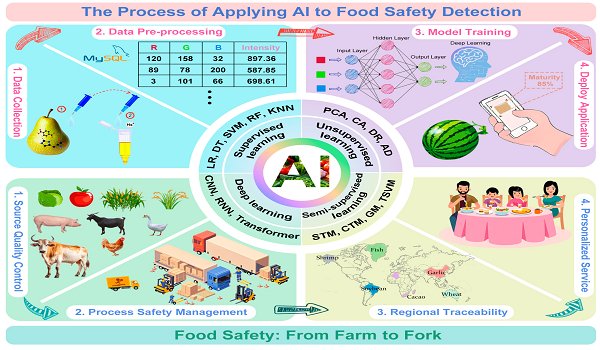
Food manufacturers are increasingly turning to artificial intelligence (AI) and automation to strengthen safety standards, improve compliance, and prevent contamination risks before they escalate, according to industry experts.
Drew Gaputis, Principal at Deloitte, highlighted how advanced technologies such as computer vision, anomaly detection and automation are enabling companies to proactively manage food safety.
“These tools allow manufacturers to detect potential safety issues early and contain them before they become widespread,” Gaputis said, adding that investments in AI-driven systems are expected to accelerate in the coming years.
Beyond plant-level safety, AI is also playing a critical role in helping companies meet evolving regulatory requirements. Under the Food Safety Modernization Act, the U.S. Food and Drug Administration has introduced stricter traceability norms aimed at quickly identifying and removing contaminated products from the market.
Although enforcement of the traceability rule has been deferred to July 2028, experts believe early adoption of AI-enabled systems will give companies a competitive edge. Enhanced digital visibility across supply chains allows manufacturers to track products end-to-end, improving accountability and enabling faster response to potential risks.
Despite its potential, integrating AI into food manufacturing operations is not without hurdles. Gaputis noted that companies often struggle with data management and demonstrating return on investment, particularly for large-scale transformations.
While smaller operational gains can be achieved quickly, full-scale adoption requires rethinking processes and organizational structures. Leading consumer packaged goods (CPG) firms are now redesigning workflows and defining clearer ownership across functions to maximise the benefits of AI.
Another critical challenge is workforce adaptation. Experts stressed that successful digital transformation depends heavily on employee buy-in and transparent communication. Addressing concerns around job security and demonstrating how AI can enhance—not replace—human roles is essential.
As food manufacturers navigate these challenges, the consensus is clear: AI is set to become a cornerstone of modern food safety, shifting the industry from reactive responses to proactive, predictive risk management.