

India’s fresh produce export industry is entering a phase where packaging efficiency is becoming just as important as product quality. Rising freight costs, pressure on cold-chain infrastructure, and growing sustainability expectations are forcing exporters to rethink the way fruits and fresh-cut products are packed and transported.
One of the biggest inefficiencies in the current system lies in the amount of unused space inside conventional produce packaging. Traditional trays and clamshells often leave gaps inside cartons and pallets, reducing overall loading efficiency and increasing transportation costs. In many cases, exporters are effectively paying to move “empty air” along with the product.
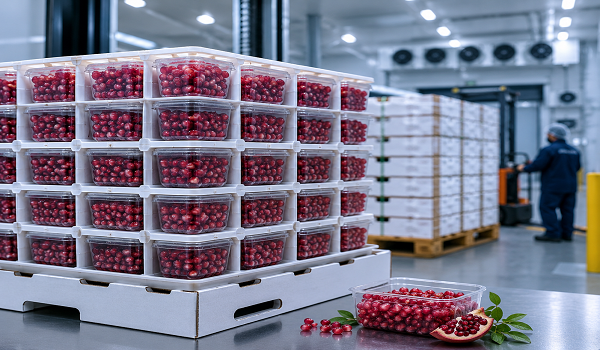
It is against this backdrop that Ecopak, in collaboration with Norwegian packaging company Q-Bic, is piloting a new cube-based packaging model in India. The concept focuses on maximising carton utilisation, improving pallet density and reducing unnecessary packaging weight without compromising product protection or shelf life.
The project is currently being evaluated through pomegranate aril trials. Under the conventional system, a standard polystyrene box carries around 90 trays of 125 g arils, translating to roughly 11.25 kg of net product. With the Q-Bic cube-based arrangement, the same box configuration can potentially hold 180 trays, increasing the product load to 22.5 kg per box. According to the company, this higher density could also contribute to nearly 25 percent savings in air-freight costs when both volume and weight are considered together.
The innovation is not limited to space optimisation alone. The packaging material itself has also been redesigned to reduce weight. Conventional trays used in these applications weigh around 11 g, while the newly developed Q-Bic trays weigh nearly 6 g, reducing packaging consumption per tray by approximately 45 percent. On a product basis, packaging usage drops significantly, helping lower both material consumption and logistics burden.
Temperature management remains one of the most critical factors in fresh produce logistics, particularly in dense export packing formats. To address this challenge, Ecopak has developed a configuration where gel-ice packs are positioned at the centre of the cube arrangement instead of being placed loosely on top. The objective is to maintain more uniform cooling across the shipment while preserving packing density.
Beyond pomegranate arils, the companies are also evaluating cube-based formats for blueberries, cherries, grapes, fresh-cut fruits, coconut chunks, snack packs, dry fruits and selected ready-to-eat applications. Many of these categories face similar challenges involving temperature sensitivity, fragile handling requirements and inefficient carton utilisation.
Early modelling indicates that the system could reduce primary packaging material by nearly 20–25 percent and secondary packaging by as much as 50–60 percent in certain applications. The increase in pallet density could also reduce the number of pallets required for transporting the same volume of product, creating both operational and environmental benefits.
The initiative also marks another important development for India’s sustainable packaging sector. Ecopak and Q-Bic are introducing a PLA-based compostable tray-and-lid solution for fresh pomegranate arils, creating a fully bio-based alternative to conventional plastic formats. Designed specifically for fresh-cut produce, the pack aims to combine product visibility, hygiene, stacking efficiency and cold-chain compatibility within a compostable structure.
Commercial rollout in India is expected to take place gradually through customer-led applications where the packaging benefits have already been validated through trials. With local manufacturing forming a key part of the strategy, the model may also position India as a regional supply base for nearby export markets looking for more efficient and sustainable fresh produce packaging solutions.