

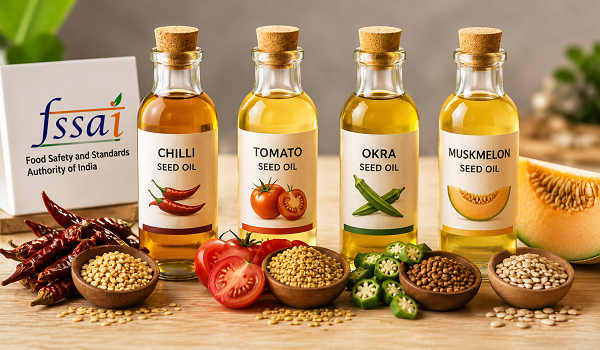
The Food Safety and Standards Authority of India (FSSAI) has released draft regulations proposing quality and safety standards for a new category of edible oils known as “Minor Seed Oils,” marking a significant step towards regulating emerging plant-based oil sources in the country.
The proposed amendment, introduced under the Food Safety and Standards (Food Products Standards and Food Additives) Regulations, brings four niche oils—chilli seed oil, muskmelon seed oil, okra seed oil and tomato seed oil—within the ambit of formal food safety standards.
According to the draft norms, these oils must be extracted from clean, mature seeds using processes that preserve their natural characteristics. The regulator has stipulated that the oils should be clear in appearance and free from rancidity, sediment and separated water. To ensure product authenticity and prevent adulteration, the use of added colours, flavours and mineral oils has been prohibited. All batches will also be required to test negative for toxic Argemone oil.
The proposed standards establish separate quality parameters for cold-pressed or virgin oils and refined oils. For cold-pressed and virgin variants, the maximum permissible acid value has been fixed at 4.0 mg KOH/g, while refined oils must not exceed 0.6 mg KOH/g. Limits for volatile matter and soap content have been capped at 0.2 per cent and 0.005 per cent, respectively.
FSSAI has also prescribed stringent limits for contaminants and heavy metals. Iron levels have been capped at 5.0 mg/kg for cold-pressed oils and 2.5 mg/kg for refined oils, while copper content must not exceed 0.4 mg/kg and 0.1 mg/kg, respectively.
The draft regulations draw a clear distinction between extraction methods. Oils produced through solvent extraction using hexane will not be permitted for direct consumer sale and must undergo refining before entering the market. The refined oils must contain no more than 5.0 mg/kg of residual hexane. In contrast, cold-pressed and virgin oils are required to be free from chemical solvents altogether.
The regulator has further proposed that food additives may be used only in refined versions of these oils, subject to approved limits. The use of additives in cold-pressed and virgin oils has been completely prohibited.
In addition to the quality specifications, manufacturers of these oils will be required to comply with existing food hygiene, contaminant and labelling requirements under India’s food safety regulations, including the Food Safety and Standards (Labelling and Display) Regulations, 2020.
The proposed standards are expected to provide a regulatory framework for a growing segment of speciality oils while ensuring product quality, consumer safety and transparency in the marketplace.