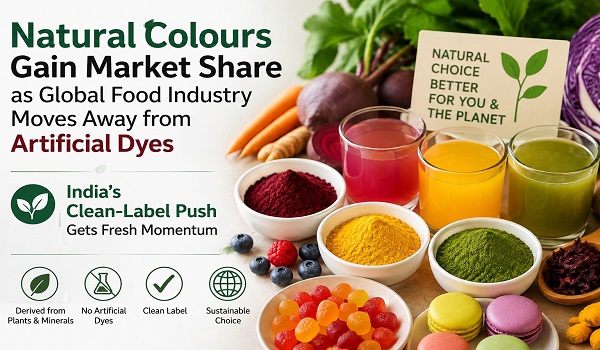

The global food industry’s transition away from artificial food colours is beginning to deliver commercial gains, with products formulated using natural colours significantly outperforming those containing synthetic dyes, according to a new report by the National Confectioners Association (NCA) and RTI International. The findings could have important implications for India, where regulators and food companies are increasingly focusing on clean-label products and natural ingredients amid growing consumer awareness.
The report found that food and beverage products using natural colours recorded a 24.4% increase in sales during 2025, while products carrying artificial colours posted a marginal growth of just 0.1%. The trend signals a notable shift in consumer preferences as governments worldwide tighten scrutiny on synthetic food additives and encourage manufacturers to adopt naturally derived alternatives.
The confectionery and beverage segments—traditionally among the largest users of artificial colours—also reflected the changing landscape. Sales of candies formulated with natural colours rose nearly 20%, compared with just 0.2% growth for products using artificial colours. In beverages, naturally coloured products registered a 12% rise in sales, while artificially coloured variants again managed only a negligible 0.2% increase.
The findings come as food manufacturers face mounting regulatory pressure, particularly in the United States, where the Food and Drug Administration (FDA) has urged companies to phase out synthetic food dyes by the end of the year. Several US states have also introduced restrictions or bans on certain artificial colours, accelerating the industry’s transition.
For years, global confectionery and beverage companies had resisted abandoning synthetic dyes because bright colours are considered integral to brand identity and consumer appeal. Earlier attempts by major companies to switch to natural alternatives met with limited success, largely because consumers perceived naturally coloured products as less visually appealing.
However, the latest sales data suggests that consumer attitudes are evolving, giving manufacturers greater confidence to invest in reformulation.
Despite the positive momentum, artificial colours continue to account for a significant share of the food market. According to the report, products containing one of the six FDA-approved certified synthetic colours generated approximately US$57.8 billion in sales, representing 7.1% of total food and beverage sales.
The transition is also expected to be gradual due to supply chain and economic challenges. Natural colour ingredients remain available in much smaller volumes than synthetic dyes, while reformulating products can cost between US$50,000 and US$500,000 per stock keeping unit (SKU), depending on the complexity of stability testing, sensory evaluation and regulatory compliance.
Nevertheless, companies that have successfully adopted natural colours are beginning to see commercial benefits. PepsiCo’s Simply NKD versions of Doritos and Cheetos generated around US$3 million in sales during their first month in the market, while Texas-based Atkinson Candy Company reported a 60% increase in sales of its Chick-O-Stick brand within five years of eliminating artificial colours.
India’s clean-label opportunity
For India, the global shift presents a significant growth opportunity for both food manufacturers and agricultural suppliers. Demand for naturally derived colour ingredients sourced from turmeric, beetroot, paprika, annatto, spirulina, butterfly pea flower and marigold is expected to rise as multinational food companies diversify their supply chains.
India, already one of the world’s largest producers of spices and botanical ingredients, is well positioned to become a major supplier of natural food colours to global markets. The trend also aligns with the country’s expanding clean-label food segment, where consumers are increasingly seeking products with simpler ingredient lists and fewer artificial additives.
Domestic FMCG companies have also been steadily expanding portfolios featuring natural ingredients, while premium and health-focused brands are using clean-label positioning as a key differentiator. Industry experts believe this trend could further boost investments in natural ingredient extraction, food processing and value-added agricultural products.
At the regulatory level, the Food Safety and Standards Authority of India (FSSAI) has been strengthening food labelling norms and encouraging greater transparency in packaged foods. Although India has not announced a nationwide phase-out of artificial colours similar to the US, the global regulatory direction is expected to influence product development strategies for companies operating in both domestic and export markets.
Industry observers say the shift towards natural colours is no longer merely a compliance exercise but an emerging business opportunity. Companies that successfully balance visual appeal, product stability and consumer expectations could gain a competitive advantage as clean-label products continue to gain traction across global and Indian markets.