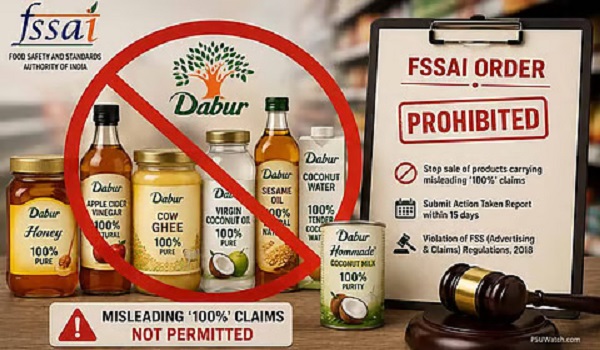

India’s food safety regulator has directed consumer goods giant Dabur India to immediately halt sales of several products bearing “100%” claims that authorities say are misleading and unsubstantiated, marking the latest in a series of enforcement actions targeting labeling practices across the food industry.
The Food Safety and Standards Authority of India (FSSAI) named a range of affected products, including Organic Apple Cider Vinegar, Organic Honey, Homemade Coconut Milk, sesame oil, and cow ghee. The regulator said labels describing these items as “100% Natural,” “100% Pure,” “100% Purity Guaranteed,” “100% Organic,” and “100% Tender Coconut Water” run afoul of the Food Safety and Standards (Advertising & Claims) Regulations, 2018, on the grounds that such claims are vague, impossible to verify, and likely to deceive consumers.
FSSAI noted this isn’t the company’s first warning on the matter, stating that Dabur had previously received notices instructing it to drop the disputed language from its packaging and marketing.
In a statement posted to Instagram, the regulator said it had instructed Dabur to “immediately prohibit the sale of the food products identified in the notice and all other food products carrying misleading ‘100%’ claims,” and to file an Action Taken Report within 15 days.
The regulator also raised a separate concern involving organic certification. It alleged that Dabur’s Himalayan Organic Apple Cider Vinegar and Organic Honey carried the Jaivik Bharat logo without a valid organic endorsement from FSSAI, a violation of the Food Safety and Standards (Organic Foods) Regulations, 2017.
Taken together, FSSAI characterized the case as involving two distinct categories of non-compliance: misleading advertising language and unauthorized use of organic certification marks.
The action follows closely on the heels of separate FSSAI enforcement moves against a packaged drinking water company and a health supplement manufacturer, underscoring what appears to be a broader regulatory push to hold food and consumer product companies to stricter labeling and safety standards.