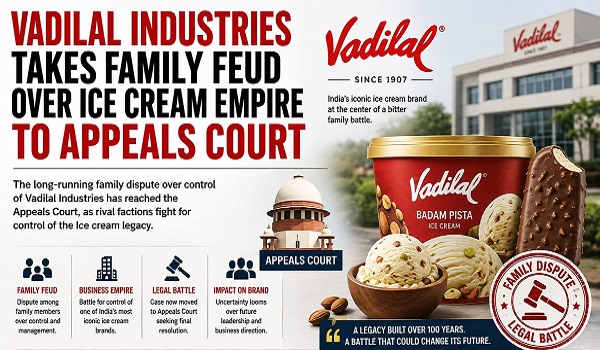

A long-simmering dispute within the family behind India’s Vadilal ice cream brand has escalated, with Vadilal Industries now challenging a court order that shielded its Mumbai branch from interference by the company’s Ahmedabad faction.
The appeal targets a single-judge ruling that had barred Vadilal Industries, its affiliate Vadilal International, and the Ahmedabad branch from obstructing the Mumbai branch’s ability to manufacture, distribute, and market ice cream and juices under the Vadilal name. A division bench comprising Justice Ravindra Ghuge and Justice Gautam Ankhad has scheduled the matter for hearing on October 6.
The underlying relief was granted on June 30 by Justice Amit Borkar, who found that the Mumbai branch’s decades-long right to use the Vadilal brand across western and southern India appears, at least on a preliminary basis, to stem from a 1993 family settlement rather than a commercial license that could be revoked at will.
The Mumbai faction had turned to the courts under Section 9 of the Arbitration and Conciliation Act, seeking interim protection after accusing the Ahmedabad branch of moving to terminate agreements that permitted Mumbai-based operations to sell Vadilal-branded products in Maharashtra, Goa, Karnataka, Kerala, and the region formerly known as undivided Andhra Pradesh.
The dispute traces back to a 1993 settlement that split the family business between the two branches following disagreements over management and expansion plans. That arrangement was formalized through four linked documents: a parent agreement, a branding agreement, an irrevocable power of attorney, and a registered user agreement. Tensions resurfaced after Vadilal International, which is controlled by the Ahmedabad branch, issued a notice on May 26 seeking to terminate the registered user agreement.
Ahead of the single-judge ruling, the Mumbai faction—led by Shailesh Gandhi and Vadilal Dairy International—argued that the various agreements governing use of the Vadilal name formed an inseparable part of one family arrangement, and that any disputes should be settled through arbitration as specified in the parent agreement. The Ahmedabad branch countered that repeated quality lapses and alleged food safety violations in products made by the Mumbai faction justified pulling the plug on the agreement. For its part, Vadilal Industries emphasized its status as a publicly listed company, noting that retail shareholders hold a 35% stake in the business.
In his ruling, the single judge acknowledged the stakes on both sides, noting that discontinuing the Vadilal brand after more than three decades could cause extensive disruption, while also recognizing the Ahmedabad branch’s concerns about protecting the goodwill tied to a registered trademark and the effect of alleged quality issues on public confidence.
Vadilal Industries is represented by Ativ Patel of AVP Partners, while senior counsel Venkatesh Dhond and Shalaka Patil of Trilegal represent other members of the Ahmedabad faction. The Mumbai faction’s legal team includes senior advocate Mustafa Doctor and counsel Hiren Kamod, alongside Faraz Alam Sagar of IndusLaw.