

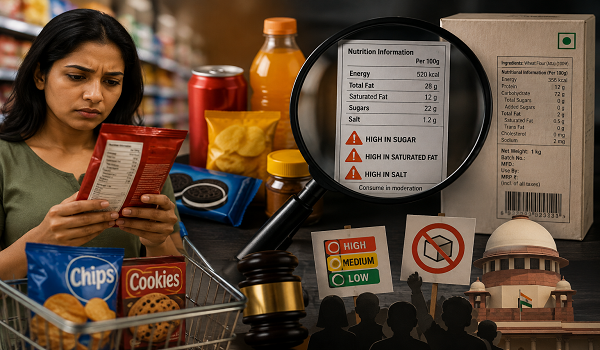
India’s push for prominent health warnings on packaged foods has become the centre of a growing battle between public-health advocates, regulators and the food industry.
The Food Safety and Standards Authority of India (FSSAI) has stepped back from plans for interpretive, colour-coded front-of-pack labels highlighting products high in sugar, salt and fat. Instead, it has proposed a simpler black-and-white nutrition disclosure. The approach is now facing scrutiny from the Supreme Court as campaigners seek stronger warnings.
The debate has gained attention because the same multinational food brands often sell products with different formulations and labelling practices across countries.
A striking example is Fanta. A can sold in London contains 63 calories, while the Indian version contains significantly more sugar and includes an artificial colourant that can require prominent health warnings on certain European products. In India, much of this information remains on the back of the pack.
Food companies have argued that warning symbols may confuse consumers and fail to reflect India’s diverse food habits. Industry representatives have also suggested that greater emphasis should be placed on portion control and consumer education.
Critics, however, point out that several multinational companies already use interpretive labelling elsewhere. Coca-Cola and its bottling partners have adopted traffic-light-style labels in parts of Europe, while Nestlé has used interpretive labels in Britain for years.
The debate comes amid growing concern about India’s changing health profile. A Lancet study cited in the report estimates that as many as 450 million Indians could be overweight or obese by 2050. Industry estimates also suggest that a large proportion of products in India’s packaged food and beverage market may be high in fat, sugar or salt.
The Supreme Court has entered the debate following petitions from health activists seeking stronger front-of-pack warnings. The court has urged regulators to examine international approaches while keeping India’s public-health responsibilities in focus.
Consumer awareness is also increasing rapidly. Social-media creators such as Revant Himatsingka, popularly known as Food Pharmer, have brought ingredient lists, sugar levels and differences between Indian and overseas formulations into mainstream discussion.
Those formulation differences are becoming an important trust issue. The report notes that India’s standard KitKat contains 4.5% cocoa solids, compared with at least 22% cocoa in the milk chocolate used in the Australian version. Indian Maggi noodles use palm oil across variants, while several British versions use sunflower oil.
Companies say recipes vary because of local tastes, regulations, ingredient availability and affordability. Yet consumers are increasingly asking why products carrying the same global brands can differ significantly between markets.
Some companies are already responding. Nestlé announced in 2024 that it would introduce sugar-free Cerelac in India following criticism over added sugar.
The larger issue, therefore, extends beyond the design of a nutrition label. As India’s packaged-food market expands and consumers become more label-conscious, companies may face growing pressure to explain not only what is printed on the packet, but also what goes into it.
For food businesses, transparency is increasingly becoming more than a regulatory requirement. It is becoming a question of consumer trust.