

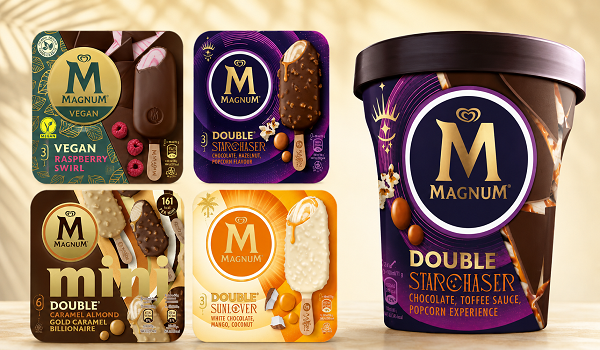
The Magnum Ice Cream Company is looking to turn ice cream into more than an after-dinner treat, with its post-Unilever strategy increasingly focused on portable formats, snacking occasions and faster product innovation.
Following its separation from Unilever in late 2025, the company has begun exploring ways its brands can compete not only within the freezer aisle but also with chocolates, chips, crackers and other everyday snacks.
The company, whose portfolio includes Magnum, Ben & Jerry’s, Talenti and Yasso, generates more than $9 billion in annual revenue. As an independent ice cream business, it is now seeking to accelerate product development while expanding the occasions when consumers choose frozen products.
Briana Bennett, head of ice cream research and development in North America at Magnum, said the company’s independence has helped streamline decision-making and encouraged its teams to think differently about how individual brands can attract consumers.
The change reflects a wider challenge facing ice cream manufacturers. With supermarket freezers already crowded with flavours and variants, simply adding another flavour may no longer be enough to create meaningful differentiation. Magnum is therefore putting greater emphasis on formats, portion sizes and new consumption occasions.
Ben & Jerry’s, for example, has expanded into ice cream bars, giving consumers a portable, portion-controlled alternative to the brand’s traditional pints. The format also allows the brand to compete more directly with confectionery and other impulse snacks.
Yasso is being developed differently. Known for lower-calorie and protein-focused frozen products, the brand has expanded into formats such as sandwiches and bites. Yasso pints have also been introduced, taking the brand into the conventional spoonable ice cream segment while retaining its health-focused positioning.
Rather than following the same innovation formula across its portfolio, Magnum plans to give individual brands distinct roles. The company believes products need to remain consistent with what consumers already expect from a particular brand. A low-sugar Ben & Jerry’s product, for instance, could conflict with the brand’s strongly indulgent identity.
Magnum is also looking for opportunities to transfer successful ideas between brands. Familiar flavours associated with Good Humor, including Strawberry Shortcake and Creamsicle, have been adapted for Breyers pints, using established consumer recognition to support new launches.
Moving into new formats, however, is not simply a packaging exercise. Bars, bites, sandwiches and pints can require different formulations, ingredients, production processes and equipment.
Chocolate illustrates the challenge. A chocolate formulation suitable for a pint may behave very differently when used as the coating of an ice cream bar. As a result, even a relatively straightforward product extension can require substantial R&D and manufacturing adjustments.
Technology is expected to play a growing role in solving these challenges. Magnum is increasingly using artificial intelligence and software tools to refine concepts and shorten product-development timelines. The company is also examining its accumulated R&D data, including previous consumer tests and product experiments, to identify older ideas that could be adapted for current market opportunities.
The strategy signals a broader shift in how one of the world’s largest ice cream businesses views growth. Instead of relying primarily on new flavours to generate excitement, Magnum wants to increase the number of occasions when consumers consider ice cream.
For the company, the next growth opportunity may therefore be less about convincing shoppers to try another flavour and more about making ice cream relevant at different moments throughout the day—turning a product traditionally associated with dessert into a more regular part of the snacking market.