

FSSAI Weighs Front-of-Pack Warnings for Foods High in Sugar, Salt and Fat
India could move towards prominent warning labels on packaged foods as FSSAI reconsiders its earlier position amid Supreme Court scrutiny and growing concern over obesity and diet-related health risks.
India is moving closer to introducing prominent front-of-pack warning labels for packaged foods containing high levels of sugar, salt and fat, a regulatory change that could have significant implications for food and beverage manufacturers.
The Food Safety and Standards Authority of India (FSSAI) has proposed a system that would allow consumers to identify products containing excessive levels of key nutrients without having to study the detailed nutritional information printed on the back of the pack.
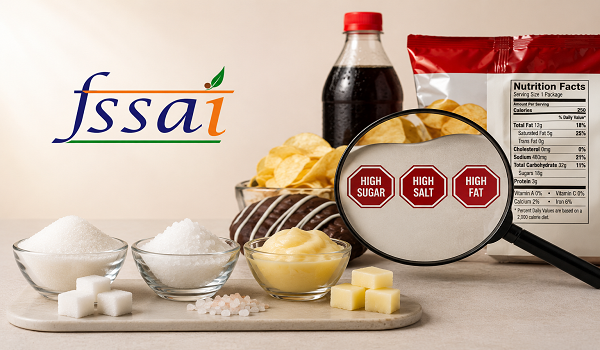
According to the proposal submitted to the Supreme Court, products high in two or more specified nutrients, including saturated fat, sugar and salt, could be required to display a red-coloured hexagonal warning on the front of the package. The declarations could include terms such as “HIGH FAT,” “HIGH SUGAR,” “HIGH SALT” or “HIGHLY SWEETENED BEVERAGE.”
The proposal represents an important shift in FSSAI’s position following years of debate over front-of-pack nutrition labelling and increasing scrutiny from the Supreme Court over delays in implementing stronger consumer warnings.
One of the key issues under consideration is how FSSAI will determine whether a product qualifies as “high” in a particular nutrient. Instead of applying a uniform threshold based on 100 grams of product, the regulator is examining the possibility of assessing nutrient levels according to typical serving sizes.
This could mean different thresholds for different food categories. A pickle, for instance, might be assessed on a serving of around five grams, while a beverage such as buttermilk could be evaluated on a substantially larger serving.
Food companies have argued that serving-based calculations could provide consumers with a more realistic understanding of their actual nutrient intake.
The proposed regulations are being closely watched by India’s packaged-food industry, including major multinational and domestic manufacturers. Industry representatives have previously raised concerns that prominent warning symbols could oversimplify nutritional information or potentially confuse consumers.
Coca-Cola India executive Mili Bhattacharya reportedly questioned at an industry meeting whether warning symbols alone would significantly change consumer behaviour. Meanwhile, Parle Products chief marketing officer Mayank Shah has argued that assessing products on a per-serving basis could be more consumer-friendly than relying solely on per-pack declarations.
Harsh Gursahani, partner at PLR Chambers, which advises companies on food law, said the industry supports clear front-of-pack nutritional information, but stressed that thresholds for sugar, salt and fat should be science-based, transparent and appropriate for Indian dietary patterns.
FSSAI is reportedly considering introducing the system in phases, allowing manufacturers time to redesign packaging and comply with the new requirements. Single-ingredient products are expected to be exempt under the proposal.
The debate is gaining urgency as India faces rising levels of obesity and diet-related health problems. A Lancet study cited in FSSAI’s filing estimates that around 450 million Indians could be overweight or obese by 2050.
For manufacturers, the eventual regulations could extend beyond packaging changes. Depending on the final thresholds, companies may have to review formulations, serving recommendations and product portfolios to avoid prominent warnings.
After nearly a decade of debate, front-of-pack labelling is therefore emerging as a major test of how India balances consumer information, public-health priorities and the practical concerns of its rapidly expanding packaged-food industry.