

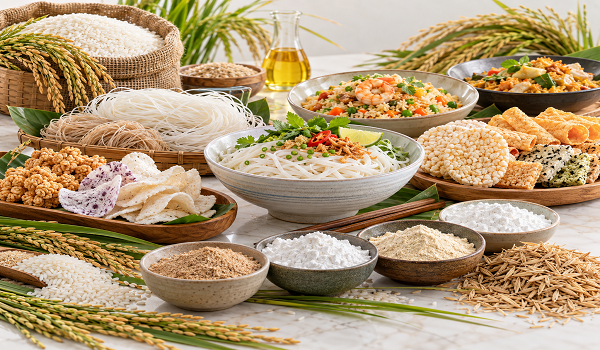
India’s rice industry is increasingly looking beyond traditional grain exports as processors and exporters explore higher-value opportunities in rice-based foods, ingredients, oils, bioenergy and industrial materials.
These emerging possibilities will be discussed at the Bharat International Rice Conference (BIRC) 2026, scheduled to be held in New Delhi from October 23-25. A key session titled “Beyond Raw Rice: The Next Billion-Dollar Opportunity” will examine how India can generate greater value from every tonne of rice produced.
The session will conclude with an IREF-EY assessment aimed at identifying rice-derived products that offer the strongest combination of market demand, achievable margins, investment requirements and export potential, according to the organisers.
Several rice-derived categories are witnessing strong global growth. The global rice-noodle market is projected to increase from $6.4 billion in 2024 to $11 billion by 2030, according to Grand View Research. Rice bran oil is another promising segment, with the global market expected to grow from $4.8 billion in 2023 to $6.3 billion by 2030.
India has considerable scope to expand rice bran oil production. A 2024 NITI Aayog report estimated the country’s potential production at around 1.9 million tonnes, including nearly 850,000 tonnes of untapped potential.
Specialised ingredients are also gaining importance. The global rice-protein market is projected to rise from $168.5 million in 2023 to $281.4 million by 2030. BIRC 2026 will examine opportunities in rice protein, rice flour and functional starches, with discussions focusing on processing requirements, customer specifications and commercial viability.
The opportunity is not limited to food products. Rice husk, traditionally considered a by-product, is increasingly being used as a source of industrial materials. The global market for silica produced from rice-husk ash is projected to grow from around $640.6 million in 2025 to $1.41 billion by 2033. Rubber and tyres accounted for about 40% of the market’s revenue in 2025.
The use of rice-husk-derived silica is already gaining traction in the tyre industry. Goodyear announced in 2025 that it was using silica derived from waste rice-husk ash in its European truck-racing tyres.
The conference will broadly examine three routes for creating more value across the rice ecosystem: premium and speciality rice, consumer products such as noodles, snacks and ready-to-eat foods, and improved utilisation of bran, flour, protein, starch, husk and other by-products.
Rice-derived beverages, including sake and ethanol, will also feature in the discussions. Japan’s sake exports reached 45.9 billion yen in 2025, around 6% higher than the previous year, according to the Japan Sake and Shochu Makers Association.
Rajeev Setia, President, Basmati, Indian Rice Exporters’ Federation (IREF), said the next phase of growth would depend on increasing the value generated from every tonne rather than simply raising export volumes.
“The next opportunity is not simply to export more tonnes of rice, but to earn more value from each tonne,” Setia said.
The IREF-EY assessment will evaluate demand, margins, processing yields, investment needs, market access and export potential. It will also assess how much of the projected global growth Indian companies can realistically capture.
For India, the exercise signals a broader shift from treating rice largely as an agricultural commodity towards building higher-value businesses around the grain and its by-products, potentially opening new opportunities in foods, ingredients, bioenergy and industrial applications.