

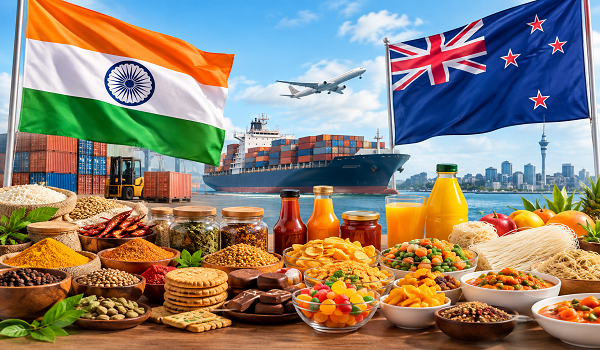
The India-New Zealand free trade agreement (FTA) is expected to provide a major boost to India’s agricultural and processed food exports by offering duty-free access to the New Zealand market, according to the Trade Promotion Council of India (TPCI).
The agreement will come into force on October 20, with tariffs on a wide range of Indian value-added food products being reduced to zero from the first day of implementation.
According to TPCI, processed foods, spices, seasonings, confectionery, bakery products, packaged cereals, sauces, fruit juices and processed vegetables, which currently attract import duties of up to 5%, will receive zero-duty access under the agreement.
The tariff elimination is expected to improve the competitiveness of Indian exporters and open new opportunities for food-processing companies, particularly micro, small and medium enterprises (MSMEs), looking to expand their presence in international markets.
TPCI Chairman Mohit Singla said the agreement would provide Indian exporters with immediate zero-duty access across product categories, strengthening their competitive position in the Oceania market.
“By securing immediate 100 per cent zero-duty access across all product lines, Indian exporters, particularly in food processing, textiles, and light engineering, gain an unparalleled competitive edge in Oceania,” Singla said.
For India’s food-processing sector, the agreement could encourage a greater shift towards exports of value-added products rather than dependence primarily on agricultural commodities. Categories such as bakery products, confectionery, spices, sauces, fruit-based beverages and processed vegetables could benefit from the improved tariff environment.
The duty concessions are also expected to support Indian companies seeking greater participation in Indo-Pacific supply chains. Lower tariff barriers could make Indian food products more price-competitive in New Zealand while providing exporters with an opportunity to establish longer-term relationships with distributors, retailers and institutional buyers.
TPCI said it plans to assist MSMEs and agri-food businesses in taking advantage of the market access provided by the agreement. Its efforts will focus on helping companies understand technical requirements, meet applicable market standards and build sustainable buyer relationships in New Zealand.
The council also plans to conduct specialised exporter awareness programmes and targeted buyer-seller meetings, particularly for businesses operating in agri-food processing and MSME manufacturing clusters.
The focus is expected to go beyond the immediate tariff advantage. Exporters will also need to address areas such as product quality, packaging, compliance, logistics and market preferences to convert zero-duty access into sustained commercial opportunities.
For smaller Indian food businesses, the agreement could be particularly significant by reducing one of the cost disadvantages associated with entering an overseas market.
The implementation of the FTA is therefore expected to create a more favourable environment for Indian value-added agricultural and processed food exports. By improving market access and reducing tariff costs, the agreement could help Indian companies broaden their presence in New Zealand while encouraging greater exports of higher-value food products.