

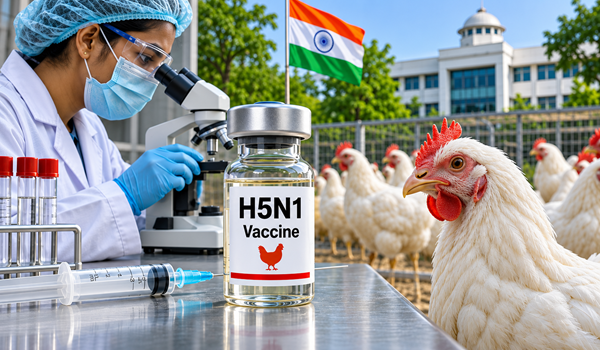
Developed by ICAR’s high-security lab, the vaccine targets one of the deadliest strains of avian influenza and is being hailed as a milestone for animal health and self-reliance.
Union Agriculture Minister Shivraj Singh Chouhan unveiled the country’s first indigenously developed vaccine against the H5N1 bird flu virus for chickens.
ICAR-National Institute of High Security Animal Diseases (NIHSAD) in Bhopal developed the vaccine. NIHSAD is one of the country’s leading facilities for research on dangerous animal pathogens. Officials from the Union Agriculture Ministry said this is the first vaccine of its kind made in India against the H5N1 virus of Clade 2.3.2.1a. That strain belongs to the highly pathogenic avian influenza (HPAI) family.
“This vaccine is an example of India’s self-reliance,” Chouhan said at the launch. He presented the breakthrough as proof that Indian science can build its own answers to serious biological threats.
A disease that wipes out entire flocks
Highly pathogenic avian influenza, commonly known as bird flu, is among the most feared diseases in poultry farming. It affects chickens and many other bird species, and it spreads fast. When an outbreak hits, almost 100 per cent of infected birds can die.
For farmers, an outbreak can mean losing an entire flock within days. In India, confirmed outbreaks have usually led to strict containment measures, including culling birds within affected zones, movement restrictions and temporary curbs on the sale of poultry products. These steps hurt both small backyard poultry keepers and large commercial farms, and they unsettle consumers and markets.
A vaccine developed for a strain that circulates in the region gives authorities a new tool. Officials hope it can help prevent these heavy losses rather than only respond after an outbreak.
Why “indigenous” matters
The launch fits the Centre’s wider push for self-reliance in agriculture and animal husbandry. A vaccine designed and developed at home can be shaped to the virus strains found in the country, and it reduces dependence on imported biological products. Experts say domestic capability matters especially for fast-changing viruses like influenza, where speed and a close match to local strains can decide how well a vaccine works.
Building the vaccine at NIHSAD also highlights the role of India’s high-containment laboratories. These labs are designed to safely handle dangerous animal diseases, and that capacity is essential for this kind of research.
Leaders attend the launch
The unveiling ceremony in Bhopal was attended by several public figures. They included Madhya Pradesh Sports and Youth Welfare and Cooperatives Minister Vishwas Sarang and Bhopal BJP MP Alok Sharma, along with officials and scientists.
The ministry has not yet given details on when and how the vaccine will be rolled out. Still, the launch marks a turning point in India’s approach to bird flu. Until now, the country’s response has relied mainly on surveillance, culling and containment. A home-grown vaccine could add prevention to that list.
For millions of people whose livelihoods depend on poultry, and for a country that eats more eggs and chicken every year, the launch is a significant development.