

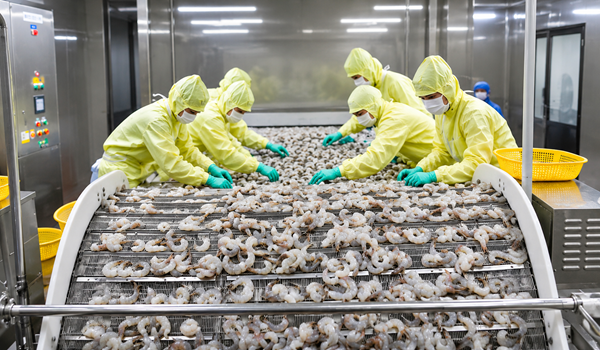
Vietnam is preparing to expand its shrimp industry further, setting an ambitious production target of 1.5 million tonnes for 2027 while aiming to generate export revenue of US$4.6–4.7 billion. The announcement follows encouraging growth in shrimp farming and overseas shipments during 2026, strengthening the country’s position in the international seafood market.
The targets were announced at a conference held on November 21, 2026, in Ca Mau province, where Vietnam’s Ministry of Agriculture and Environment reviewed the performance of its brackish-water shrimp industry and outlined priorities for the coming year.
According to the ministry, shrimp production is estimated to reach approximately 1.469 million tonnes in 2026, representing a 4.5% increase over the previous year. The country’s shrimp farming area has expanded only marginally, reaching 759,566 hectares, indicating that higher productivity rather than substantial expansion of cultivation areas has contributed to the increased output.
Black tiger shrimp has been a major contributor to this growth, with production estimated at approximately 450,000 tonnes, an increase of 13.8%. Whiteleg shrimp, which continues to dominate the sector in terms of volume, is expected to account for around 1.022 million tonnes.
For 2027, Vietnam intends to maintain approximately 755,000 hectares under brackish-water shrimp cultivation. The production target includes 1.05 million tonnes of whiteleg shrimp and 450,000 tonnes of black tiger shrimp.
Export performance has also remained encouraging. During the first ten months of 2026, Vietnam’s shrimp exports generated approximately US$4.22 billion, registering a 9% increase compared with the corresponding period of 2025.
China and Hong Kong emerged as the largest export destinations, accounting for shipments worth approximately US$1.42 billion. The United States, Japan, the European Union and Australia also remained important markets for Vietnamese shrimp.
The Mekong Delta continues to form the backbone of Vietnam’s shrimp industry, accounting for nearly 94% of the country’s farming area and approximately 90% of production. The region’s extensive aquaculture infrastructure and established processing industry contribute significantly to export-oriented operations.
However, the government has acknowledged several challenges that could affect future growth. Rising production costs, inconsistent shrimp seed quality, disease outbreaks, fragmented farming operations and dependence on imported broodstock remain important concerns.
Deputy Minister of Agriculture and Environment Vo Van Hung has emphasised the need to move beyond simply increasing production volumes. Greater attention must be given to reducing costs, improving farming efficiency, strengthening biosecurity and producing higher-value seafood products.
The government is also encouraging better cooperation between farmers, cooperatives, processors and exporters, alongside improvements in environmental monitoring, traceability and aquaculture infrastructure.
For international seafood markets, Vietnam’s expansion plans are significant. The country competes with major shrimp-producing nations, including India and Ecuador, particularly in important markets such as the United States, China, Japan and Europe.
Increasing production and export ambitions could intensify competition, making product quality, pricing, processing efficiency and sustainability increasingly important for exporters.
Vietnam’s 2027 strategy therefore reflects a broader shift towards improving profitability and global competitiveness rather than concentrating solely on higher production. The success of this approach will depend on how effectively the industry addresses farming challenges while maintaining consistent quality and meeting international market requirements.