

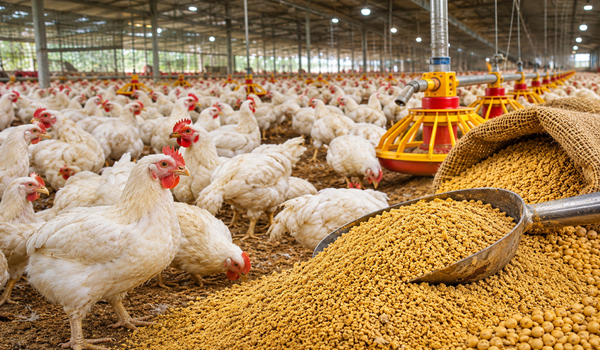
Rising soybean prices are prompting India’s poultry feed manufacturers to reduce their dependence on soybean meal, a major protein ingredient used in poultry nutrition. Industry estimates suggest that soybean meal usage in feed formulations has declined by approximately 25–30%, as producers explore more economical alternatives to manage increasing production costs.
According to Hanish Kumar Sinha, Agricultural Economist and Director at Acharyapuram Agri Business Management School, New Delhi, the rising cost of domestically available soybean meal has encouraged feed manufacturers to reconsider their ingredient combinations. Speaking to Asian Agribiz, he estimated that soybean meal usage in feed rations had fallen by 25–30%.
The figure reflects an expert assessment rather than an officially measured industry-wide decline. Nevertheless, it highlights the growing financial pressure on poultry producers, for whom feed represents one of the largest operating expenses.
Soybean meal has traditionally been an important ingredient in poultry feed because of its high protein content and essential amino acids, which support bird growth, egg production and overall performance. However, its increasing price has made it difficult for manufacturers to maintain affordable feed formulations.
The industry is consequently showing greater interest in alternative protein sources, particularly Distillers Dried Grains with Solubles (DDGS), a by-product generated during grain-based ethanol production.
DDGS is emerging as an economical ingredient for poultry, dairy and aquaculture feed. Its growing availability from India’s expanding ethanol industry is providing manufacturers with additional options for managing raw material costs.
Recent industry estimates indicate that soybean meal containing approximately 45–48% protein costs ₹55–59 per kg. In comparison, rice-based DDGS, containing around 45–50% protein, is available at approximately ₹25–29 per kg. Maize-based DDGS, with a lower protein concentration, costs considerably less.
This price difference is encouraging feed manufacturers to examine partial substitution, although the quantity that can be used depends on the nutritional requirements of different livestock and poultry categories.
Industry reports suggest that DDGS is already replacing approximately 10–20% of soybean meal in certain broiler and layer feed formulations. The substitution offers opportunities for reducing costs, but it also requires careful attention to ingredient quality and feed performance.
Poultry nutrition specialists emphasise that cheaper ingredients cannot simply be exchanged on an equal-weight basis. Protein quality, amino acid balance, digestibility and consistency must be considered to ensure that bird health and productivity are not compromised.
The Poultry Federation of India has also stressed the importance of reliable quality standards for DDGS. Variations between production batches could affect feed formulations, making regular testing and transparent quality reports necessary.
Meanwhile, domestic soybean meal production is facing pressure. USDA estimates indicate that India’s output declined from 8.7 million tonnes in 2024–25 to approximately 7.86 million tonnes in 2025–26, with a further reduction projected for 2026–27.
The changing situation could have wider implications for soybean processors, feed manufacturers and poultry farmers. While alternative ingredients may help control expenses, sustained changes in consumption could also influence future demand for domestically produced soybean meal.
For India’s poultry industry, the immediate challenge is to maintain the nutritional quality of feed while keeping production economically viable. With raw material prices remaining a concern, feed formulation strategies are likely to become increasingly important in determining profitability and competitiveness.