

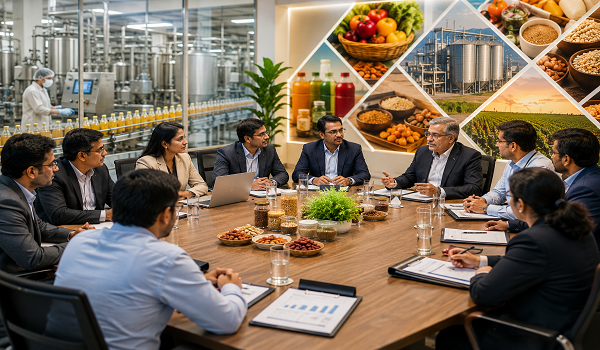
The Centre has initiated consultations with industry stakeholders to shape the next phase of the Production-Linked Incentive Scheme (PLISFPI) for the food processing sector, aiming to strengthen domestic manufacturing, enhance global competitiveness, promote innovation, and deliver greater benefits to farmers, MSMEs, and agri value chains.
The Union government has begun consultations with industry stakeholders to design the next phase of the Production-Linked Incentive Scheme for the Food Processing Industry (PLISFPI), signalling its intent to expand fiscal support for one of India’s fastest-growing manufacturing sectors.
Addressing the consultation on Wednesday, Food Processing Industries Secretary Avinash Joshi said the government is working towards an evidence-based, industry-led framework for the next generation of incentives. The proposed policy will focus on strengthening domestic manufacturing, improving India’s global competitiveness, encouraging innovation and technology adoption, increasing value addition, and ensuring greater benefits for farmers, MSMEs, and agricultural value chains.
As part of the initiative, the Ministry of Food Processing Industries will establish two working groups—one to address misconceptions surrounding processed foods and another to develop a science-based, growth-oriented strategy to promote India’s food processing industry.
Reaffirming the government’s commitment to making India a global food processing hub, Joshi said all recommendations received during the consultations would be carefully evaluated to support innovation, strengthen value chains, and generate sustainable employment.
The meeting was attended by senior ministry officials, representatives from IFCI Ltd, Invest India, industry associations, leading food processing companies, and beneficiaries of the existing PLI scheme.
According to the ministry, the current PLISFPI has exceeded its investment targets. Against a committed investment of ₹7,722 crore, companies have invested over ₹9,207 crore across 212 manufacturing units in 22 states—nearly 20% higher than the original target.
The scheme has also delivered strong business outcomes. Sales of PLI-supported products grew at a compound annual growth rate (CAGR) of 10.82%, increasing from ₹58,758 crore in FY20 to ₹1,08,854 crore in FY26. Exports registered an 11.05% CAGR, reaching ₹20,840 crore during the same period.
Additionally, the scheme has generated approximately 3.35 lakh direct and indirect jobs while attracting over ₹3,265 crore of investment into notified tribal areas. Millet-based processed foods emerged as a key growth segment, recording a 104% CAGR in sales, with millet procurement increasing by 97% annually.
During the consultations, industry stakeholders recommended that the next phase of the PLI scheme adopt a more flexible and outcome-based approach. Suggestions included expanding coverage to emerging food categories and introducing differentiated incentives linked to exports, import substitution, research and development, innovation, employment generation, and capital investment.
Participants also sought stronger support for global branding and marketing, faster reimbursement mechanisms, improved backward integration for critical raw materials, simplified compliance procedures, rationalised eligibility norms, and greater incentives for automation and quality enhancement.
High-potential sectors identified for future growth included nutraceuticals, functional foods, plant-based proteins, dairy ingredients, marine value-added products, animal feed, and pet food. Industry representatives also called for investments in research infrastructure, clinical validation facilities, Centres of Excellence, export promotion, indigenous ingredient development, and the creation of globally competitive Indian food brands.