

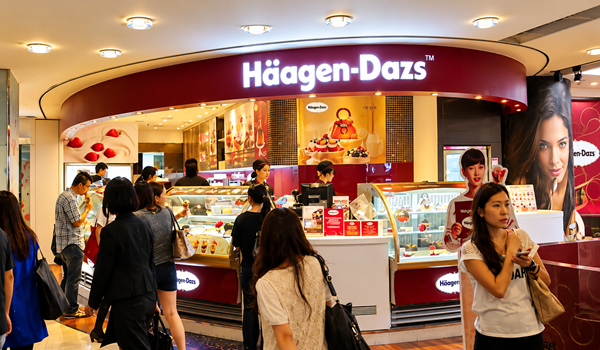
Walk into any of Japan’s 56,189 convenience stores and the freezer section is likely to hold a 111-millilitre cup of Häagen-Dazs. Priced at around 350 to 380 yen and carrying 250 to 300 calories depending on flavour, it is aimed squarely at calorie-conscious shoppers. The brand’s route to that shelf, however, has been far from smooth.
An invented name with a Danish look
Häagen-Dazs was founded in the Bronx, New York, in 1961 by Polish immigrant Reuben Mattus. He made up the name so that it would sound “cold, clear, luxurious and Danish,” even printing a map of Scandinavia on the carton and adding an umlaut. In truth, the name had no meaning. Mattus, who once described himself as a marketing man, said getting a foreign-sounding name was the first priority.
Mattus and his wife Rose began with three flavours, vanilla, coffee and chocolate, using more cream and all-natural ingredients to create what is now called super-premium ice cream. He credited a friend’s advice about reducing “overrun,” or air, in ice cream for the formula.
Pillsbury takes the brand abroad
By the end of 1982, Häagen-Dazs had 244 franchises in the United States, but profits were modest, with an estimated $7 million earned on $115 million in sales. Pillsbury bought the company for around $75 million and set out to expand internationally.
In Japan, Pillsbury followed the pattern set by Baskin-Robbins: offer something new, maintain high standards and work with a local partner. Häagen-Dazs Japan was announced on September 18, 1984, with Pillsbury holding 50 per cent, Suntory 40 per cent and Takanashi Farms 10 per cent.
The first store opened on November 1, 1984, in Aoyama’s Plaza 246. Queues formed, with four to five thousand customers a day, and single-scoop cones sold for 76 cents. The target market was rich, fashion-conscious people aged 18 to 35, and the company relied on word of mouth.
Stagnation and rivalry
By 1994, the brand ran about 95 shops. Its ice cream was made with Hokkaido milk, partly out of necessity since Japan did not allow US milk imports until 1991. Ownership changed repeatedly, from Pillsbury to Grand Metropolitan, then Diageo, and finally General Mills in 2001, while Suntory and Takanashi kept their stakes.
Competition was tough. Baskin-Robbins had over 400 outlets and a family-friendly image, and Cold Stone Creamery briefly opened around 30 shops between 2006 and 2013. Between 1997 and 2013, shop sales stagnated and rents in luxury districts kept climbing.
A bold pivot
The last scoop shop closed in 2013 under then vice president Bela Schweiger, who repositioned Häagen-Dazs as a “special treat” for women aged 25 to 34 and 45 to 55. Singer and actress Sakiko Shiba fronted new commercials, and cup labels were simplified for quick recognition in convenience stores.
Record sales
The strategy has paid off. In fiscal 2025, Häagen-Dazs Japan, led by President Kyoko Igarashi, posted record annual sales of ¥55.6 billion, up 13 per cent. The Milk mini-cup, made with 100 per cent Hokkaido milk, drove growth, especially among women aged 20 to 34.