

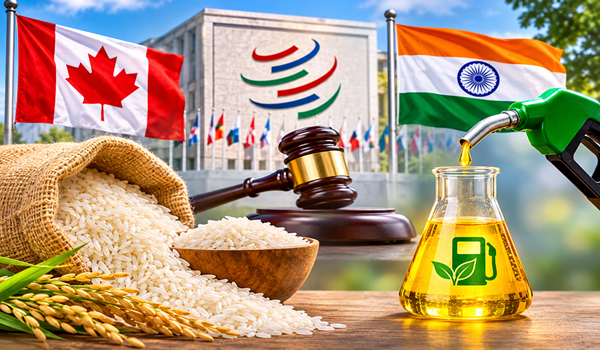
Canada has questioned India at the World Trade Organization over its use of government-held rice to make ethanol. The move puts a spotlight on how grain from public stocks is being turned into industrial fuel, a policy that touches energy security, farm economics and global trade rules all at once.
Canada has asked India to share details on how much public rice is being supplied for ethanol, how that rice is priced, and what safeguards are in place to make sure food-security commitments are not weakened. The questions reflect concern that state-held grain should not be shifted into fuel production without clear disclosure and firm rules on allocation.
Queries like these at trade forums are rarely about a single shipment or season. They usually signal unease about the policy framework itself, especially when a country uses state procurement stocks for industrial purposes. In this case, the scrutiny goes to the heart of India’s grain policy, which has long balanced procurement, public distribution and market intervention, and now also has to serve newer energy goals.
India has been pushing hard to raise the share of ethanol blended into petrol, and grain has emerged as one way to meet that target. Surplus rice from public stocks can be an attractive raw material. But every tonne sent to fuel is a tonne that does not reach food channels, which makes the issue sensitive in a country where food inflation and welfare schemes remain politically charged.
Domestically, the ethanol programme has been presented as a way to cut oil imports, support farmers and lower emissions. Trading partners, however, want to know whether the rice is being sold at market rates, at subsidized prices or through a special allocation system. The distinction matters at the WTO. If public stocks are diverted on terms that look preferential, other members may argue the arrangement creates an uneven playing field. If the volumes are limited and clearly linked to managing surplus, the policy will be easier to defend. Canada’s move suggests that not all members have yet seen enough evidence on this point.
Food security is the thread running through the whole issue. Public rice stocks exist to keep prices stable, support welfare programmes and cushion supply shocks. When some of that grain goes to ethanol, governments must show that domestic supplies are protected and that vulnerable consumers are not affected. This is especially important in India, where rice is a staple and the state plays a major role in buying and distributing it.
The immediate result is likely to be more documentation, clarification and negotiation within the WTO process. India may be asked to explain the scale of rice use for ethanol, the reasoning behind its pricing and the steps it takes to protect food security. Depending on its response, the matter could stay a technical exchange or grow into a wider trade debate over farm stocks and energy policy.
The episode highlights a dilemma facing many governments: how to meet climate targets while protecting food supplies and keeping trust in public procurement systems. India’s ethanol ambitions are unlikely to slow down. But Canada’s challenge shows that the choice of raw material for clean fuel can carry diplomatic and commercial consequences well beyond the energy sector.