

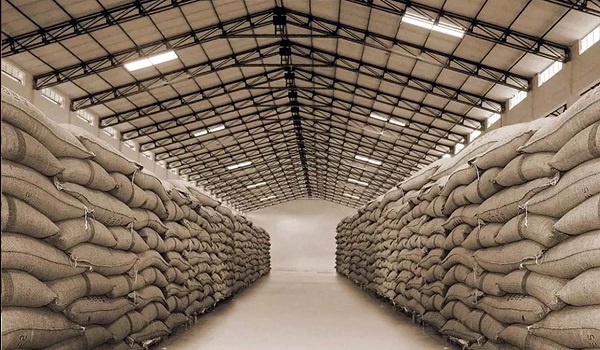
India is launching a massive grain storage expansion drive, pledging $15 billion to modernize its outdated infrastructure and reduce the country’s severe post-harvest losses, which currently account for nearly 25% of annual food grain production.
The move aligns with a broader effort shared by China, as both Asian giants seek to secure food supply for over 1.4 billion people each, amid rising domestic demand, volatile weather patterns, and a global push toward food self-sufficiency.
India, which produces an estimated 350 million tonnes of food grains annually, faces a staggering 47% storage shortfall. The nation currently has the capacity to store only 145 million tonnes of grain, forcing much of the harvest into conventional warehouses or open-air facilities, which are prone to spoilage from pests, moisture, and poor handling.
According to Rajan Aggarwal, Vice President of AGI India — a subsidiary of Canadian storage systems company AGI — up to a quarter of India’s harvested grains are wasted due to insufficient scientific storage. “Minimizing post-harvest and storage losses can ease the pressure to produce more,” he said.
India’s planned investment aims to construct an additional 70 million tonnes of storage through thousands of new steel silos, smart warehouses, and mobile storage units, particularly in remote and hilly areas. The initiative will use a hub-and-spoke logistics model, with hub silos connected by rail and spoke silos linked by road, improving efficiency and cost-effectiveness.
The country expects a record wheat output of 115 million tonnes in the 2025–26 marketing year, while rice production, which saw nine straight years of growth, is expected to stabilize at 143 million tonnes. Corn production is also projected to hit a record 42 million tonnes, driven in part by government policies supporting ethanol blending.
The Food Corporation of India (FCI), a key player in India’s grain management system, is also upgrading its facilities. It currently operates 2.3 million tonnes of silo capacity and is developing an additional 4.1 million tonnes under the public-private partnership (PPP) model. Overall, FCI manages over 41 million tonnes of storage through a mix of owned and leased infrastructure.
To support private investment in storage, the Agriculture Marketing Infrastructure (AMI) scheme continues to offer subsidies up to 33.3% for projects in hilly and special regions. As of October 2024, over 48,000 such infrastructure projects had been sanctioned under the scheme.
Meanwhile, AGI India is expanding its manufacturing footprint, with a new fully automated plant under construction near Hosur, Tamil Nadu, expected to be operational by the third quarter of 2026. The company already operates a facility in Bengaluru and has delivered grain storage systems with a cumulative capacity of 700,000 tonnes.
China, facing similar post-harvest losses, has increased its storage capacity by 36% in the past decade, reaching 700 million tonnes. The country has also implemented advanced technologies such as “four-in-one” storage systems — combining mechanical, ventilation, fumigation, and cooling processes — to reduce spoilage. Loss rates in Chinese grain warehouses have now dropped below 1.2%, according to the Henan University of Technology.
Tanner Ehmke, a grain economist with CoBank, noted that while India’s grain industry is heavily regulated, its commitment to large-scale storage expansion could deliver major benefits. “In India, there is a huge amount of waste now, about 25% of their crop. Simply having a more efficient storage system that reduces waste is going to increase their level of food security,” he said.
Experts agree that strategic investments in grain storage will be critical as both nations balance rising food demand, land scarcity, and climate resilience.
“Reliable storage supports the public distribution system and helps India respond better to food crises,” said Aggarwal. “With less wastage and better grain quality, India can even enhance its export capabilities while strengthening its agricultural economy.”