

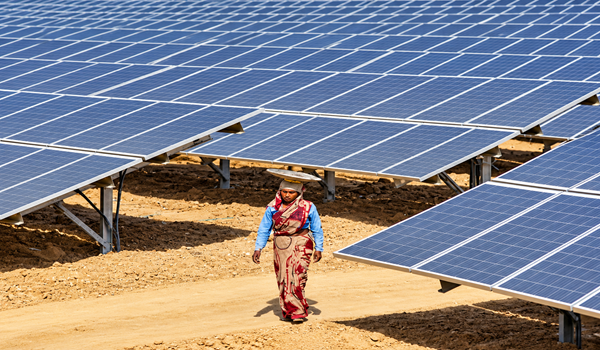
The government is working on a policy to boost the adoption of agrivoltaics in India, with around 30 per cent of the country’s 160 million hectares of cropland estimated to be suitable for projects that allow farming and solar power generation on the same land.
Union Minister for New and Renewable Energy Pralhad Joshi said the policy is meant to raise farmers’ incomes. Speaking at the Agrivoltaics World Conference 2026, themed “Powering the Global South,” in the national capital, he noted that agrivoltaics has started in many parts of the world and also helps address the problem of land availability.
Joshi said about 4 acres of land are needed to install 1 MW of solar capacity. He pointed out that 85 per cent of India’s farmers are small and marginal and cannot afford to give up farming to make room for solar plants. Combining the two uses, he suggested, offers a way around that problem.
According to the minister, Maharashtra, Rajasthan, Andhra Pradesh, Madhya Pradesh, Karnataka and Uttar Pradesh together account for nearly 50 per cent of India’s estimated agrivoltaic potential. He added that the global agrivoltaic market has crossed 18.4 gigawatts of installed capacity, and that India can learn from international experience.
Joshi was candid about the economics. Agri-PV plants cost 25 to 30 per cent more than conventional ground-mounted solar projects, mainly because of the additional infrastructure needed for elevated, tilted structures. Power from agrivoltaics can be generated at Rs 3.20 per unit, compared with Rs 2.60 per unit for ground-mounted projects. He said this gap will have to be bridged to make the proposition viable, and called for scaling up to bring down costs.
Speaking to reporters later, Ministry of New and Renewable Energy (MNRE) Secretary Santosh Kumar Sarangi confirmed that a policy is in the works. The draft will be placed in the public domain, and all stakeholders, including states, will be invited to share suggestions before modifications are made. Sarangi said the government is targeting a capacity of 5 GW over the next few years to begin with, and will assess the response from states before going further.
A dedicated 10-GW agri-PV component, aimed at promoting the co-location of solar panels with crops, is also expected to form part of the proposed PM-KUSUM 2.0 scheme. An official indicated that plans are underway for a central scheme to help states deploy agrivoltaics, under which solar panels would be erected on stilts above standing crops.
German Ambassador to India and Bhutan Jasper Wieck assured support for joint research on pilot agrivoltaic sites. “Here we will test how agriculture and solar power generation can be combined economically and sustainably on the same land,” he said.
The proposed policy will need to balance farmers’ interests, project costs and state-level participation. How the cost gap with conventional solar is addressed, and how states respond to the draft, will likely decide how quickly agrivoltaics moves from pilot projects to farms across the country.