

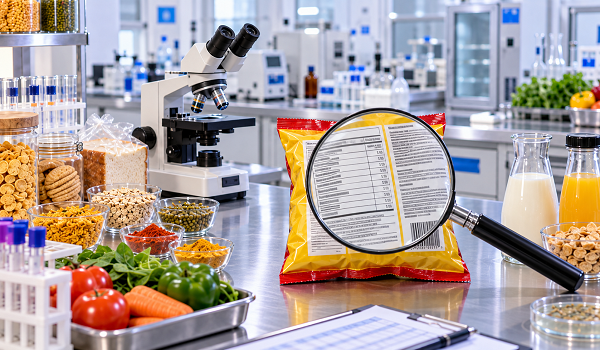
India’s proposed front-of-pack labelling regime is drawing attention to a critical but less visible part of the food industry: the laboratories that generate the nutritional data appearing on product labels. As the Supreme Court examines the framework proposed by the Food Safety and Standards Authority of India, laboratories and manufacturers are asking whether the country’s testing system is sufficiently standardised to support declarations with major regulatory and commercial consequences.
Ashwin Bhadri, CEO of Equinox Labs, said nutrition data would face much greater scrutiny once nutrient levels begin influencing how products are presented to consumers. Under a warning-label system, a laboratory result could determine whether a packet carries a prominent alert for high sugar, salt or saturated fat. The accuracy and consistency of that result would therefore affect compliance, brand perception and potentially sales.
India already has an established food-testing network. FSSAI prescribes methods for different food categories, while laboratories accredited by the National Accreditation Board for Testing and Calibration Laboratories operate under ISO/IEC 17025 standards. However, capacity and accreditation alone may not guarantee uniform results. Experts say validated methods must be applied consistently across diverse food matrices, supported by reliable sampling and common rules for interpreting findings.
Added sugar is one of the more difficult areas. A laboratory can measure the total sugar in a product, but distinguishing naturally occurring sugar from sugar added during formulation or processing may require information beyond the test result. Ingredient lists, recipes, processing records and regulatory definitions can all affect the final classification.
The distinction becomes important when warning requirements are tied to numerical limits. Bhadri referred to the 2024 ICMR-NIN Dietary Guidelines, which identify levels above 4.2 g per 100 g for added fat, 3 g per 100 g for added sugar and 0.625 g per 100 g for salt in solid foods as levels of concern. FSSAI’s 2026 draft provisions relating to food served in schools also refer to these thresholds.
For manufacturers, inconsistent laboratory results could create considerable uncertainty. If identical products produce materially different findings because of variations in sampling, testing methods or interpretation, companies may struggle to determine the correct declaration. Disputes could also arise over enforcement, especially when a result decides whether a highly visible warning must appear on the package.
Some industry participants nevertheless view clearer front-of-pack information positively. Shippy Sharma, Founder and Managing Director of Earthling Consumer Products, said warnings for products high in sugar, salt and saturated fat could help consumers compare nutritional profiles without having to decipher detailed information on the back. She added that greater transparency might encourage manufacturers to reformulate products and develop healthier alternatives.
The debate is therefore moving beyond whether consumers need clearer nutrition information. Attention is shifting to how that information will be measured, verified and enforced. As the Supreme Court awaits technical and operational affidavits from the Union Government and FSSAI, the testing sector is emphasising that any front-of-pack system will be only as credible as the science supporting it.
For India’s food industry, the next stage will require more than additional laboratory capacity. Standardised sampling, validated analytical methods, consistent interpretation and dependable documentation will form the essential infrastructure beneath the country’s new generation of food labels.