

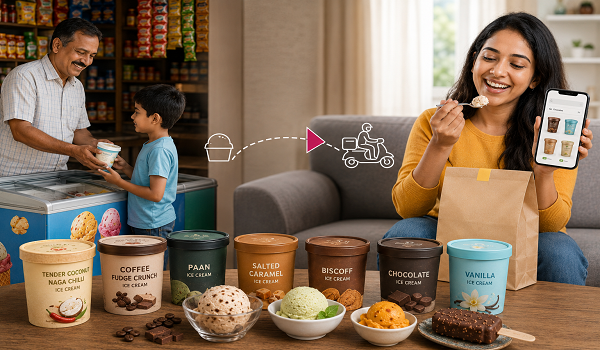
India’s ice cream market is witnessing a significant behavioural shift as consumers increasingly move from neighbourhood store purchases to quick commerce-led consumption, transforming ice cream from an occasional summer outing into an everyday indulgence.
What was once a family ritual involving post-dinner walks to local kirana stores has now evolved into an impulse-driven, at-home consumption habit powered by platforms such as Blinkit and Swiggy Instamart.
Retailers and industry players say the change reflects broader lifestyle trends, including the rise of food delivery ecosystems, indoor entertainment habits and expanding cold-chain infrastructure across urban India.
Sudhir Deshmukh, who has operated a daily-needs store since 1991, said traditional store visits for ice cream continue, but the consumer profile has changed.
“People still come after dinner, but most are above 30 or families with children. Younger consumers increasingly prefer ordering online,” he said, adding that family packs now account for a large portion of purchases. According to him, his store sold nearly ₹1 lakh worth of ice creams within 25 days during the current summer season.
Consumers also acknowledge the growing role of convenience. Muktika Kubde, a 21-year-old consumer, said online delivery platforms have largely replaced dedicated trips to ice cream shops.
“Earlier, buying ice cream meant stepping out with family. Now it’s easier to order instantly at home,” she said.
The shift is also changing the way ice cream is consumed. Individual cones and bars bought during outings are increasingly giving way to tubs and family packs consumed indoors while streaming content or during casual gatherings.
Industry players say stronger cold-chain networks and wider retail availability have enabled ice cream to move beyond its earlier positioning as a seasonal treat.
According to ice cream brand Naturals, consumers are increasingly opting for takeaway tubs and larger packs suited for home consumption and group occasions.
At the same time, flavour preferences are evolving rapidly. While classic variants such as vanilla, chocolate, mango and butterscotch continue to dominate sales, brands are witnessing growing demand for experimental and fusion flavours.
Naturals recently collaborated with Bombay Sweet Shop to launch fusion offerings such as Tender Coconut Naga Chilli and Coffee Fudge Crunch, blending familiar Indian tastes with contemporary dessert formats.
Local retailers have also observed greater consumer willingness to experiment. Deshmukh noted that brands are increasingly introducing multi-flavour tubs, kulfi-inspired variants and premium formats to attract younger buyers.
Even traditional parlours are adapting to changing consumer preferences while retaining experiential dining formats.
Taj Ice Cream, one of Mumbai’s oldest ice cream parlours, established in 1887, continues to attract multi-generational customers while expanding its menu to include flavours such as paan, Biscoff, salted caramel and passion fruit.
Aamir Hatim Icecreamwala, the sixth-generation custodian of the brand, said consumer curiosity has increased significantly in recent years.
“Earlier, people preferred familiar flavours. Today, they actively seek new experiences,” he said, adding that demand for protein ice creams and sugar-free options is also rising.
Despite the rapid growth of quick commerce, traditional parlours continue to draw consumers looking for social and experiential outings, especially in cities where legacy dessert destinations have become part of local culture and social media-driven food tourism.
Industry observers say the evolution of ice cream consumption in India reflects a broader transition in food behaviour — from planned, shared occasions to immediate, convenience-led indulgence — while continuing to retain nostalgia and emotional value across generations.