

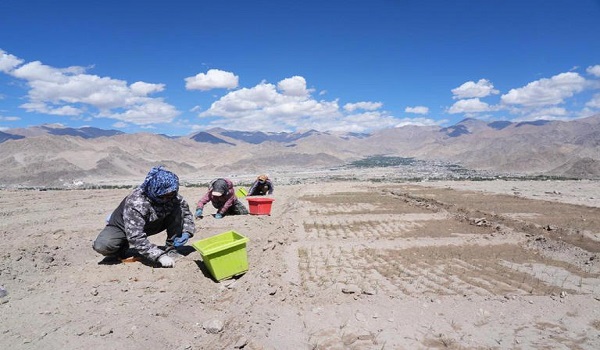
Ladakh has launched a pilot project to cultivate saffron on restored barren land in Leh, marking a new experiment in high-value agriculture in the Union Territory’s cold-desert environment.
Around 90,000 saffron corms imported from Iran, weighing approximately 800 kg, have been planted across 4,000 square metres at Spituk Pharka. The project is aimed at assessing whether saffron can be commercially cultivated under Ladakh’s distinctive high-altitude and arid agroclimatic conditions.
The trial has been launched as part of efforts to diversify agriculture and convert degraded land into productive farmland. The cultivation site is located within an 800-acre land restoration zone being developed under Project Him Sarovar.
Agriculture experts selected saffron corms weighing more than 10 grams and measuring 8–10 cm in circumference, with the objective of improving their ability to establish and produce under local conditions.
Water management is a key component of the project. Excess water diverted from the recently restored Igoo–Phey irrigation canal is being used to irrigate the cultivation area. Four adjoining storage ponds have a combined capacity of 24 million litres, providing additional water resources for the restored land.
The saffron trial follows earlier floriculture experiments in Ladakh involving crops such as Lilium and Gladiolus. The administration is now looking at saffron as another high-value crop that could expand the region’s agricultural base.
If the trial proves successful, saffron cultivation could provide an additional source of income for farmers, young people and Self-Help Groups while demonstrating the potential for commercial agriculture on previously degraded desert land.
Saffron is among India’s highest-value spice crops, and neighbouring Jammu and Kashmir accounts for nearly 90% of the country’s domestic saffron production. Introducing the crop in Ladakh could therefore add a new production region while supporting the administration’s wider focus on crop diversification.
The project is also part of a broader land-restoration effort intended to demonstrate how barren terrain can be reclaimed and converted into productive assets.
According to Ladakh administration officials, the saffron experiment is intended not only to test the crop’s suitability but also to explore new agricultural opportunities capable of improving farm incomes in the region.
The outcome of the pilot will determine whether saffron cultivation can be expanded to other suitable areas of Ladakh.