

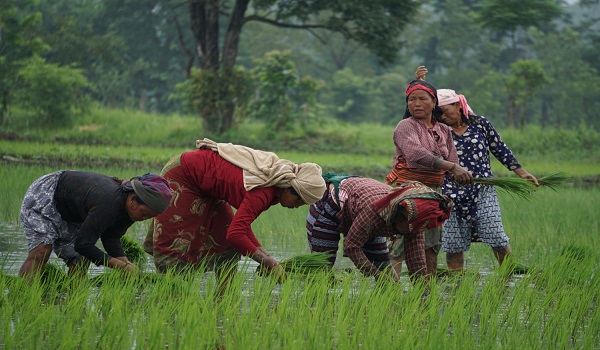
A 16-member delegation from Nepal, comprising members of parliament and led by former Minister and Nepali Congress MP Sanjay Kumar Gautam, visited Krishi Bhawan in New Delhi on July 29, 2025. Representing the Free Youth Democratic Organisation (FYDON), the delegation engaged in in-depth discussions with Devesh Chaturvedi, Secretary, Department of Agriculture & Farmers Welfare (DA&FW), and Dr. Mangi Lal Jat, Secretary, Department of Agricultural Research & Education (DARE).
The primary aim of the visit was to understand India’s progress in various agricultural domains and explore opportunities for bilateral cooperation. During the discussions, Indian officials provided a detailed overview of key areas, including soil health management, balanced fertilizer use, precision farming, irrigation techniques, agricultural marketing, crop insurance, climate change adaptation, and farmer welfare initiatives.
Addressing the delegation, Secretary Chaturvedi underlined India’s evolving agricultural strategy, which prioritises nutritional security alongside food security. He shared insights into transformative initiatives, including the promotion of Farmer-Producer Organisations (FPOs), digitisation in agriculture, and risk mitigation frameworks that have empowered Indian farmers. He also reiterated India’s longstanding cultural and diplomatic ties with Nepal and affirmed the country’s willingness to deepen cooperation in the agricultural sector.
Dr. Mangi Lal Jat, Secretary of DARE, assured the Nepali delegation of India’s readiness to share expertise in agricultural science and technology through its vast network of Indian Council of Agricultural Research (ICAR) institutes and agricultural universities. He advocated for a multi-pronged approach that includes policy collaboration, technology sharing, and enhanced engagement between farmers and agri-industries in both countries.
The visit comes on the heels of an India–Nepal Memorandum of Understanding (MoU) signed in April 2025, aimed at strengthening collaboration in agriculture. This new agreement focuses on boosting crop productivity, climate-resilient farming, post-harvest management, organic agriculture, and improving market access. It also sets up mechanisms such as a Joint Agriculture Working Group and formal collaboration between ICAR and Nepal’s NARC (National Agricultural Research Council).
Further reinforcing this relationship, India is also funding the construction of an Agriculture Promotion Centre in Nepal’s Bajura district under the High Impact Community Development Project (HICDP). This facility, which will serve as a grain collection and distribution hub, aims to benefit farmers in remote areas.
Earlier this year, in May 2025, a separate high-level Nepalese delegation visited ICAR–IARI in Delhi to explore academic and scientific partnerships, including future MoUs between Indian and Nepalese agricultural universities. These efforts are expected to enhance research collaboration, capacity building, and extension services—particularly in hill and mountain farming zones.
The parliamentary visit reflects Nepal’s growing interest in leveraging India’s agri-tech innovations and institutional knowledge to address domestic agricultural challenges. It also highlights a maturing bilateral framework that moves beyond diplomacy to practical cooperation, capacity development, and farmer-level impact.
With mounting challenges such as climate vulnerability, soil degradation, and border-region fertilizer smuggling, the India–Nepal agricultural partnership stands at a strategic crossroads—offering both countries a chance to develop shared solutions, promote regional food security, and ensure sustainable agricultural growth.