

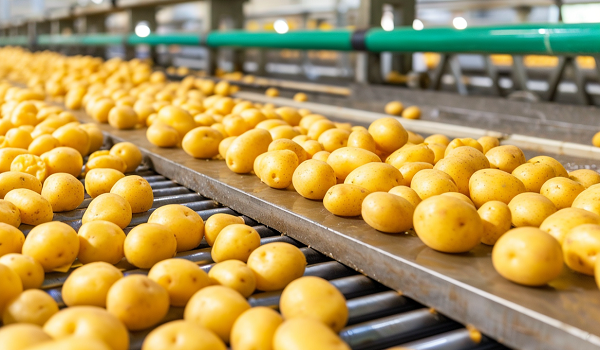
India’s processed potato industry is witnessing a remarkable export surge, with shipments to Southeast Asian markets growing more than fivefold in the past three years, according to a report by the Global Trade Research Initiative (GTRI). The growth is being fuelled by rising demand for snack and convenience foods in countries such as Malaysia, the Philippines, Indonesia, Japan, and Thailand, alongside rapid infrastructure expansion in India’s potato-processing hubs of Gujarat and Uttar Pradesh.
As per GTRI data, exports of dehydrated potato granules and pellets — used in snacks and quick-service restaurant (QSR) chains — have skyrocketed from USD 11.4 million in 2021–22 to USD 63.3 million in 2024–25, making them India’s fastest-growing processed food export category. Other potato-based products like starch, flour, chips, and ready-to-eat items also saw a sharp jump, from USD 6.2 million to USD 18.8 million in the same period.
“Nearly 80% of these shipments are headed to Malaysia, the Philippines, Indonesia, Japan, and Thailand,” said Ajay Srivastava, founder of GTRI. “India has now become an integral part of Southeast Asia’s snack and convenience-food supply chain.”
India emerges as Asia’s potato powerhouse
Gujarat and Uttar Pradesh have emerged as India’s processing powerhouses, supported by strong agricultural output and modern supply chains. With an annual potato crop of 56 million tonnes, India is now well positioned to meet growing international demand.
“New dehydration plants, contract farming initiatives, and expanded cold-chain infrastructure have helped India achieve consistent, high-quality output,” Srivastava noted. Gujarat’s Mehsana and Banaskantha districts now house state-of-the-art processing facilities, while Uttar Pradesh’s Agra and Farrukhabad are seeing new investments in dehydration and storage units.
Malaysia leads import growth
Malaysia has become India’s biggest market for processed potato exports, with imports rising from USD 5.1 million to USD 22.1 million over the past three years. The Philippines and Indonesia follow closely, with Japan and Thailand also increasing their purchases. Together, these five markets account for nearly 80% of India’s total processed potato exports.
Global shift boosts India’s edge
The report highlighted that India’s competitiveness has been strengthened by preferential tariffs under the India–ASEAN Trade in Goods Agreement and shorter shipping routes via ports such as Mundra, Kandla, and Chennai. These logistical advantages have helped India offer competitive pricing compared to European and Chinese suppliers.
Europe’s potato processors have been hit by rising energy costs and erratic harvests, while China is prioritizing domestic consumption. This shift has created an opportunity for India to position itself as a reliable, low-cost, year-round supplier for the region’s snack and QSR industries.
“India’s steady output, improving quality standards, and cost advantage have transformed it from an occasional exporter to a dependable partner for Asian food manufacturers,” Srivastava said.
With Southeast Asia’s appetite for packaged snacks and convenience foods showing no signs of slowing, India’s processed potato sector is expected to continue its upward trajectory — strengthening its role as a critical link in Asia’s fast-growing food value chain.