

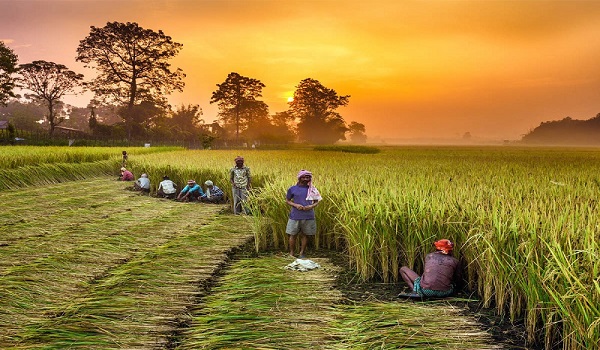
India’s agriculture sector is well-positioned to maintain a 4% growth rate over the next 10 years, NITI Aayog member Ramesh Chand said on Thursday, stressing the urgent need to scale up warehouse infrastructure to support rising production and tap export opportunities.
Speaking at an event organized by PHD Chamber of Commerce and Industry (PHDCCI), Chand said demand for agricultural commodities is projected to grow at 2.5% annually, underscoring the need to channel surplus production into industry or international markets. “We can easily assume, and easily maintain, 4% growth in the agriculture sector over the next decade,” he noted.
The farm sector posted a 3.7% growth rate in the first quarter of 2025–26.
Chand emphasised that expanding exports is a more viable route than relying solely on domestic industrial use. He also highlighted the importance of scientific storage systems, pointing out that warehousing needs differ depending on the commodity—while rice and wheat have similar requirements, maize requires distinct infrastructure.
Regulatory clarity, he said, plays a key role in encouraging investment in warehousing. Since the rollback of the three farm laws, the need to invoke the Essential Commodities Act has diminished, improving the environment for storage-related investments.
Countering widespread perception about high food wastage, Chand said India’s food losses are “not as high as believed.” At a UN conference, he noted that milk—one of the most perishable commodities—registers only 0.5% loss. Most existing losses, he added, are preventable, offering strong incentives for private investment in storage infrastructure. “The more you prevent losses, the higher the incentive for investment in warehouses,” he said.
Warehousing is essential not only for safeguarding buffer stocks but also for maintaining inter-year and intra-year price stability, a crucial factor given that food accounts for a significant share of household expenditure.
India is currently the world’s second-largest producer of agricultural commodities and the eighth-largest exporter, with foodgrain output hitting a record 354 million tonnes in 2024–25. Production is projected to reach 368 million tonnes by 2030–31, making scientific storage and post-harvest management vital for strengthening food security, raising farmer incomes, and reducing avoidable losses.