

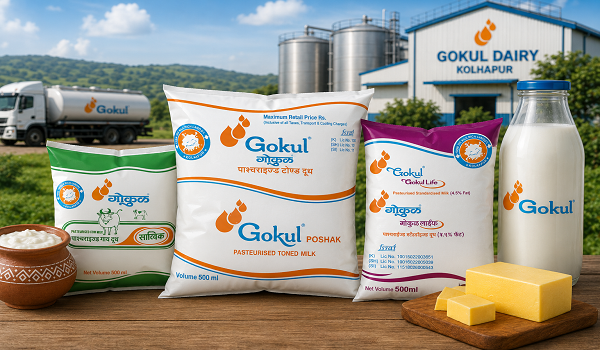
The Kolhapur Zilla Sahakari Dudh Utpadak Sangh, popularly known as Gokul Dairy, has urged consumers in Mumbai and Pune not to be influenced by a social media campaign calling for a boycott of its products over Halal certification.
The appeal follows allegations made on social media by an activist, who claimed that the certification was linked to religious promotion and targeted former Gokul Dairy chairman Navid Mushrif and Maharashtra minister Hasan Mushrif.
Gokul Dairy, which supplies around 15 lakh litres of milk daily to Mumbai and Pune, said it has been receiving calls from long-standing distributors seeking clarification amid concerns that the controversy could affect sales.
Addressing the issue, Anil Chaudhari, General Manager of Gokul Dairy, said the Halal certification has no connection with religious promotion, compulsion, or ideology and is instead a commercial requirement linked to food quality and international trade.
“The Halal certification is not related to any religious promotion, compulsion or ideology. It is a necessary commercial and quality-related requirement in international trade. The term ‘Halal’ means ‘permissible’ or ‘lawful,’ and the certification ensures that no prohibited or adulterated substances are used in the production process of food products,” Chaudhari said.
He explained that certification processes in the dairy sector involve rigorous quality checks, with all ingredients verified to ensure compliance with Halal standards.
“Therefore, this certification is considered a benchmark for quality and safety, similar to standards such as FSSAI, ISO 22000 and HACCP,” he added.
According to Chaudhari, Gokul Dairy has held Halal certification since 2018, and its current certification remains valid until March 2028.
The dairy cooperative also emphasized the role of Halal certification in supporting exports. Chaudhari noted that several countries in the Gulf region, including Saudi Arabia, the United Arab Emirates, Oman, Qatar and Kuwait, legally require Halal certification for imported food products.
“In many Islamic countries, especially in the Gulf region, Halal certification is mandatory for food imports. These countries do not grant customs clearance without Halal certification,” he said.
Highlighting Gokul Dairy’s export track record, the cooperative said it exported approximately 850 tonnes of milk powder in 2018 to countries including Turkey, Georgia, Syria, Bangladesh and the UAE. More recently, it exported 462 tonnes of butter to Azerbaijan in 2024.
The dairy further stated that demand for Indian dairy products, particularly butter and ghee, remains strong across Middle Eastern markets and that it continues to receive export enquiries from overseas buyers.
In its official statement, Gokul Dairy pointed out that several dairy cooperatives and food processing companies across India have adopted Halal certification to facilitate exports and strengthen their presence in international markets.
The cooperative reiterated that the certification should be viewed as an export compliance and quality assurance requirement rather than a religious issue, and appealed to consumers and distributors not to be misled by misinformation circulating on social media.