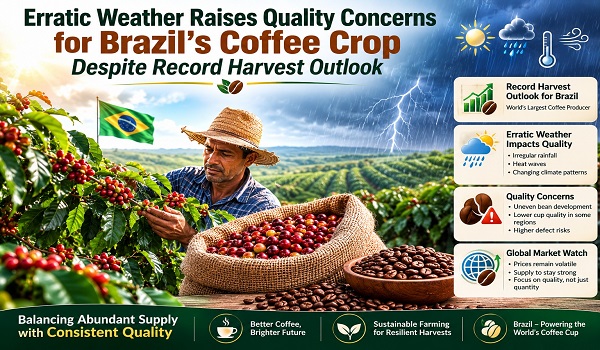

Unusually high moisture levels and early flowering in Brazil’s coffee-growing regions are raising concerns over bean quality, even as the world’s largest coffee producer remains on track for a record harvest this year.
Industry experts say persistent rainfall during Brazil’s winter harvest season—traditionally a dry period that supports harvesting, drying and exports—has disrupted field operations, delayed shipments and increased the risk of lower-quality beans. The weather anomaly has been linked to the ongoing El Niño phenomenon and has also contributed to a recent rally in global arabica coffee prices.
“Bean quality is an issue. The high moisture can lead to fermentation of the beans, causing them to fall to the ground,” said Guilherme Teixeira, Data Processing Coordinator at coffee cooperative Cooxupé, during a crop assessment event.
The delayed harvest has coincided with stronger coffee prices in international markets. Greg Oddo, Weather Strategist at global soft commodities trader Sucafina, said the prolonged rains have disrupted harvesting and logistics, supporting recent gains in benchmark arabica futures.
“The overall quality might not reach the premium standards that end-users are looking for,” Oddo noted. However, he added that the weather is unlikely to significantly affect production volumes.
Sucafina continues to project Brazil’s coffee output at a record more than 75 million 60-kg bags this season, suggesting that supply volumes will remain robust despite quality challenges.
Another unusual development has been premature flowering in July, well ahead of Brazil’s normal flowering window of September and October. Agronomists warn that multiple flowering cycles could strain coffee trees by forcing fruits of different sizes to compete for nutrients.
“The more flowering there is, the greater the competition among fruits of different sizes for the tree’s energy,” said José Donizeti Alves, Professor of Plant Physiology at the Federal University of Lavras. He cautioned that the phenomenon could increase the risk of early fruit drop.
Despite the concerns, higher soil moisture may also benefit the next flowering cycle. According to Sucafina, healthier trees with improved moisture reserves could better support future blossoms and enhance fruit retention on branches.
With Brazil accounting for a significant share of global coffee exports, the evolving weather conditions are being closely watched by growers, traders and roasters worldwide, as they could influence both the quality of the upcoming crop and global coffee prices in the months ahead.