

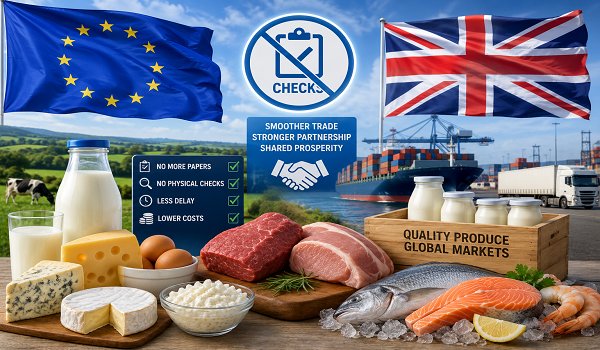
The United Kingdom and the European Union have unveiled the first details of a landmark food trade agreement that is expected to significantly reduce border bureaucracy and ease the movement of dairy, meat, fish and other agri-food products between the two markets from mid-2027.
The agreement marks a major step in resetting post-Brexit trade relations and is expected to eliminate routine paperwork and physical inspections for dairy products, cheese, eggs, fish and fresh red meat traded between the UK and the EU.
The new sanitary and phytosanitary (SPS) arrangement is also expected to simplify trade flows between Great Britain and Northern Ireland under the Windsor Framework, reducing compliance requirements for food businesses and retailers.
Under the proposed rules, exporters of fresh, frozen and processed meat will no longer need costly veterinary health certificates to demonstrate compliance with EU standards. Similar documentation requirements for plants and wood packaging materials will also be removed, while businesses supplying food products to Northern Ireland will no longer require health labels.
Although negotiations on certain aspects of the SPS framework are still ongoing, the UK Department for Environment, Food and Rural Affairs (Defra) has already issued guidance to help food producers and exporters prepare for the upcoming changes.
According to the UK government, the agreement could contribute up to £5.1 billion annually to the British economy by reducing administrative burdens and supporting growth across agriculture, food processing and export-oriented industries.
Sue Hayman, the UK’s Biosecurity Minister, described the agreement as a major opportunity for the food and drink sector.
“By cutting unnecessary delays and paperwork at the border, the agreement will make it easier for businesses to sell our world-class produce to European customers, support jobs and help ease pressure on food prices for families,” she said.
The agreement will also harmonise regulations covering food additives, colourings, animal breeding certificates, pesticides, vaccination residues, organic products and animal feed, creating a more streamlined trading environment.
Since Brexit, British exporters have faced extensive compliance requirements when shipping food products to the EU. While the UK largely refrained from imposing equivalent checks on EU imports, European authorities have continued to apply documentary checks on all food imports from Britain and physical inspections on a significant proportion of consignments.
Industry representatives have long argued that the additional bureaucracy increased costs and slowed the movement of perishable goods. Health certificates alone can cost up to £200 per shipment, adding substantial expenses for exporters.
Toby Ovens, Managing Director of Broughton Transport Solutions, recently highlighted the challenges faced by logistics providers, noting that exporters now require dozens of pages of paperwork compared to a single document before Brexit. Errors in documentation have often resulted in delays and detention of food consignments at border crossings.
Welcoming the agreement, Ben Fletcher, Chief Executive of Logistics UK, called it a “common-sense solution” that would reduce the time and money required to move fresh food products across UK and EU borders.
Negotiations on the final agreement have been underway since late 2025 and are expected to conclude ahead of the next UK-EU summit scheduled for July. Both sides are targeting a mid-2027 implementation date.
For the dairy industry, the agreement is expected to improve market access, reduce export costs and enhance the competitiveness of dairy products traded between the UK and the European Union, creating new opportunities for processors, exporters and supply chain operators on both sides of the Channel.